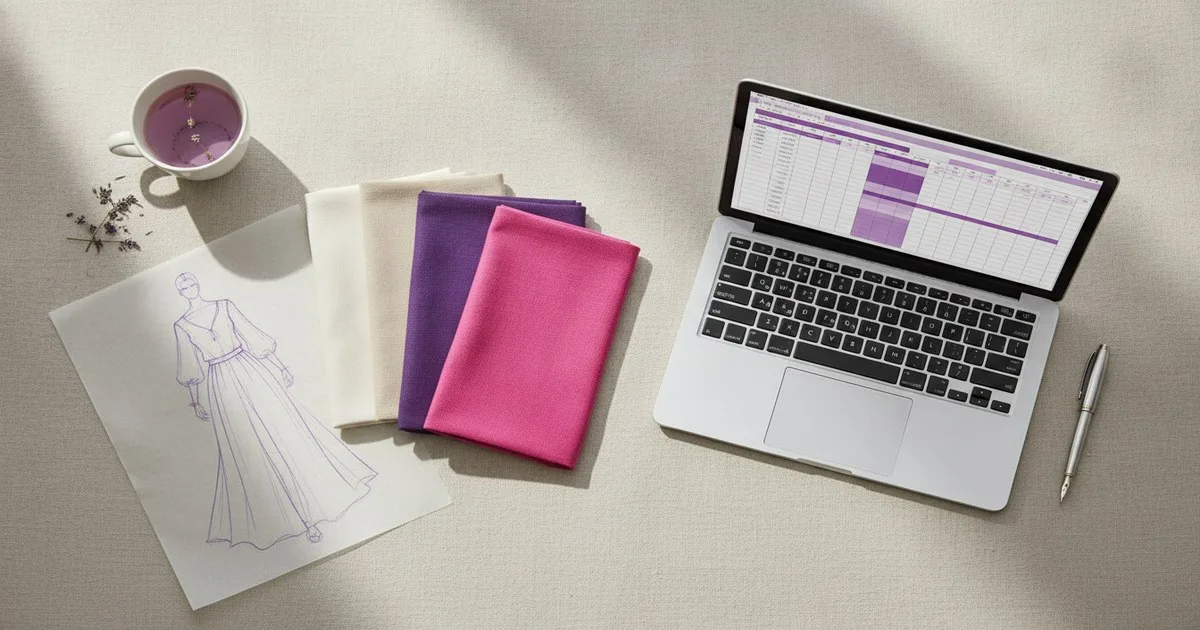
Before a single thread is cut, the clothes you wear have already lived a long digital life. Product lifecycle management software — PLM, in industry shorthand — is the invisible architecture behind that process: a connected system where designers sketch, technicians specify, suppliers quote, and quality teams approve, all inside one shared environment. You will never see it on a label, but its fingerprints are on almost everything hanging in your wardrobe.
Key takeaways
- PLM software coordinates every stage of a garment's creation, from the first sketch to the final shipment spec, inside a single connected platform.
- The quality of a finished garment — its stitching tolerances, its fabric weight, its fit — is partly determined by how precisely that information is managed in PLM long before production begins.
- Brands using digital product development pipelines can reduce physical sampling, which cuts both cost and material waste.
- Upcoming European regulation will require many products to carry a Digital Product Passport, and PLM systems are the most natural place to generate that data.
- The fashion industry was a relatively late adopter of PLM compared with sectors like aerospace, but it is now treating the software as central to digital transformation.
What exactly is PLM software, and what does it do?
Think of PLM as the memory and nervous system of a fashion brand. Every decision made during a garment's development — the colourway chosen in week three, the revised seam allowance approved in week seven, the supplier swap that happened two weeks before the order was placed — lives inside it. Without a system like this, those decisions scatter across email threads, shared drives and the heads of individuals who might leave the company.
A PLM platform typically holds:
- Tech packs — the detailed specification documents that tell a factory precisely how to construct a garment, including measurements, materials, trim details and stitch types.
- Bill of materials — a complete list of every component, from shell fabric to the thread colour on an interior seam.
- Approval workflows — structured sign-off chains so that a fit comment from a designer in London reaches a pattern team in Dhaka without getting lost in translation.
- Sample tracking — a log of every physical or digital prototype, what feedback it received, and what changed as a result.
- Supplier data — contact details, lead times, certifications, and audit records for every factory and mill in the brand's network.
Research published by the University of Manchester describes PLM as having moved from its origins as a product data management tool — essentially a glorified filing system — into a strategic pillar of digital transformation across the fashion and textile industries. The authors characterise this shift as a move from PLM 1.0 to PLM 2.0: from storing data to actively connecting people, processes and partners across global supply chains.
How does PLM affect the quality of what you buy?
This is the part most shoppers never consider. When a garment fits badly, or a seam gives way after three washes, the failure often traces back not to a careless factory worker but to a miscommunication somewhere in the development chain. A measurement written in one unit and read in another. A fabric substitution approved verbally but never updated in the spec. A revised fit note that reached the wrong version of a tech pack.
A well-implemented PLM system reduces these errors by making the specification the single source of truth. Everyone — the designer, the pattern maker, the sourcing manager, the factory — works from the same document, and every change is logged with a timestamp and a name. That traceability is not just good housekeeping; it is what allows a brand to diagnose a quality problem quickly and fix it before the next season.
The relationship between PLM rigour and garment quality is not guaranteed — a poorly configured system can create its own bureaucratic fog — but the principle holds: more precise information, communicated more reliably, produces more consistent results on the factory floor.
What does PLM have to do with sustainability?
Quite a lot, as it turns out. One of the most material environmental costs in fashion happens before a garment ever reaches a consumer: the sampling process. A single style might go through four, five or six physical prototypes before it is approved, each one consuming fabric, thread, labour and shipping miles. Multiply that by the hundreds of styles in a seasonal collection and the waste accumulates quickly.
Digital product development — creating and reviewing garments in 3D simulation before committing to physical samples — is increasingly integrated into PLM workflows. Hugo Boss has reported that around 65% of its products were developed digitally in fiscal year 2023, up from around 55% the previous year, with a stated goal of reaching more than 90% by 2025. Fewer physical samples means less material discarded, fewer air freight shipments for approval rounds, and faster iteration.
The Ellen MacArthur Foundation's work on fashion and the circular economy identifies higher-quality, longer-lasting clothing as a prerequisite for any meaningful circularity — and that quality begins in the data that PLM holds.
There is also a regulatory dimension approaching. The European Commission is developing a Digital Product Passport — a digital record attached to a product that would give consumers, repairers and recyclers access to verified information about its materials, origin and end-of-life options. PLM systems, which already hold much of this data, are the most logical source for populating those passports. Brands that have invested in clean, structured PLM data will find compliance considerably less painful than those that have not.
Why was fashion slow to adopt PLM?
The fashion industry's relationship with PLM has been complicated by its own nature. Seasons move fast, trend cycles are short, and the creative culture of many brands historically resisted the kind of structured data discipline that PLM requires. Aerospace and automotive companies — where a single product might be in development for a decade — found PLM's value proposition obvious from the beginning. Fashion, with its six-to-twelve-month development cycles and its tolerance for informal process, took longer to see the same logic.
The University of Manchester research notes that fashion is a late adopter of PLM relative to other manufacturing sectors, but that within global fashion and textile organisations the software has now become a mainstream approach to process optimisation. The shift has been accelerated by the growth of global supply chains — when a brand's design team, production team, and factories are spread across four continents, the informal systems that worked in a single building simply stop functioning.
Which PLM tools do fashion brands actually use?
The PLM market for fashion has consolidated considerably, and the tools available range from large enterprise platforms to more focused solutions aimed at growing brands.
Centric PLM
Centric PLM, now part of Dassault Systèmes, is one of the most widely deployed platforms in the fashion and consumer goods space. It covers the full development lifecycle — from concept and material sourcing through tech pack creation, supplier collaboration and quality management — and has expanded in recent years to include planning, pricing intelligence and product experience management. Its AI-powered capabilities are aimed at large organisations managing complex, multi-category portfolios across global supply chains. The breadth of the suite makes it well suited to enterprise brands; smaller labels may find the implementation investment significant.
Backbone PLM
Backbone PLM, now operated under Bamboo Rose following its acquisition in 2023, is a fashion-focused platform that targets retailers managing private-label development at scale and scale-up brands building out their product operations. It provides tooling for tech pack creation, approval workflows and supplier collaboration, with an interface that has been noted for its accessibility compared with older enterprise systems. Post-acquisition, the platform continues to be offered within Bamboo Rose's broader portfolio.
What the category still cannot solve
No PLM platform, however sophisticated, eliminates the human judgment calls that shape a garment. A system can flag that a seam allowance has changed; it cannot tell you whether the change was a good idea. It can store a supplier's certification documents; it cannot verify that conditions on the factory floor match what the documents say. PLM is infrastructure, not conscience — and the brands that treat it as a substitute for genuine supply chain accountability tend to find that out the hard way.
It is also worth noting, as our look at what fashion brands do not always tell you about their AI tools explores, that the integration of AI into PLM is still uneven: some capabilities are genuinely useful, others are marketing surface.
What is coming next for PLM in fashion?
The direction of travel is toward greater connectivity and greater automation. PLM platforms are increasingly expected to talk directly to 3D design tools, to demand-forecasting systems, and eventually to the Digital Product Passport infrastructure that European regulation is building out. The goal is a continuous thread of data from a designer's first sketch to a garment's end-of-life recycling instruction — with no manual re-entry, no version confusion, and no information lost in translation.
Fast fashion's model, which McKinsey describes as compressing development timelines to respond to near-real-time trend signals, has put particular pressure on PLM systems to handle speed without sacrificing accuracy. The tension between velocity and rigour is one the industry has not yet resolved.
For consumers, the practical implication is this: the more a brand invests in structured, connected product development, the more likely it is to produce garments that perform as described, last as long as they should, and can eventually be traced back through their supply chain. PLM is not a guarantee of any of those things. But its absence makes all of them harder.
FAQ
What does PLM stand for in fashion? PLM stands for product lifecycle management. In fashion, it refers to software that connects every stage of a garment's development — from design and material sourcing through to production specifications and supplier approval — inside a single shared platform.
Does PLM software affect the fit of my clothes? Indirectly, yes. PLM systems hold the measurement specifications and fit approval records that factories work from. When that information is precise and consistently communicated, the finished garment is more likely to match the intended fit. Errors in those records are a common source of fit inconsistency across production runs.
How does PLM relate to sustainable fashion? PLM supports sustainability primarily by enabling digital product development, which reduces the number of physical samples a brand needs to produce. Fewer samples means less material waste and fewer international shipments for approval rounds. PLM also stores the supply chain data that will underpin mandatory Digital Product Passports under incoming European regulation.
Can small fashion brands use PLM software? Yes, though the options and investment levels vary considerably. Platforms like Backbone PLM, now part of Bamboo Rose, are designed with growing and mid-sized brands in mind. Larger enterprise platforms such as Centric PLM are typically better suited to organisations with complex, multi-category portfolios and dedicated implementation resources.
What is a Digital Product Passport and how does PLM connect to it? A Digital Product Passport is a digital record — being developed under European Union regulation — that would give consumers and recyclers verified information about a product's materials, origin and end-of-life options. PLM systems already hold much of this data, making them the natural source for generating and maintaining those passports as the regulation rolls out.
Will AI replace PLM software? Unlikely in the near term. AI capabilities are being built into PLM platforms rather than replacing them — helping with tasks like automating data entry, flagging specification inconsistencies, or generating initial tech pack drafts. The underlying need for a structured, shared record of product decisions is not something AI eliminates; it is something AI can help maintain more efficiently.
Further reading
- From PLM 1.0 to PLM 2.0 — University of Manchester
- Digital Product Passport — European Commission
- Fashion and the circular economy — Ellen MacArthur Foundation