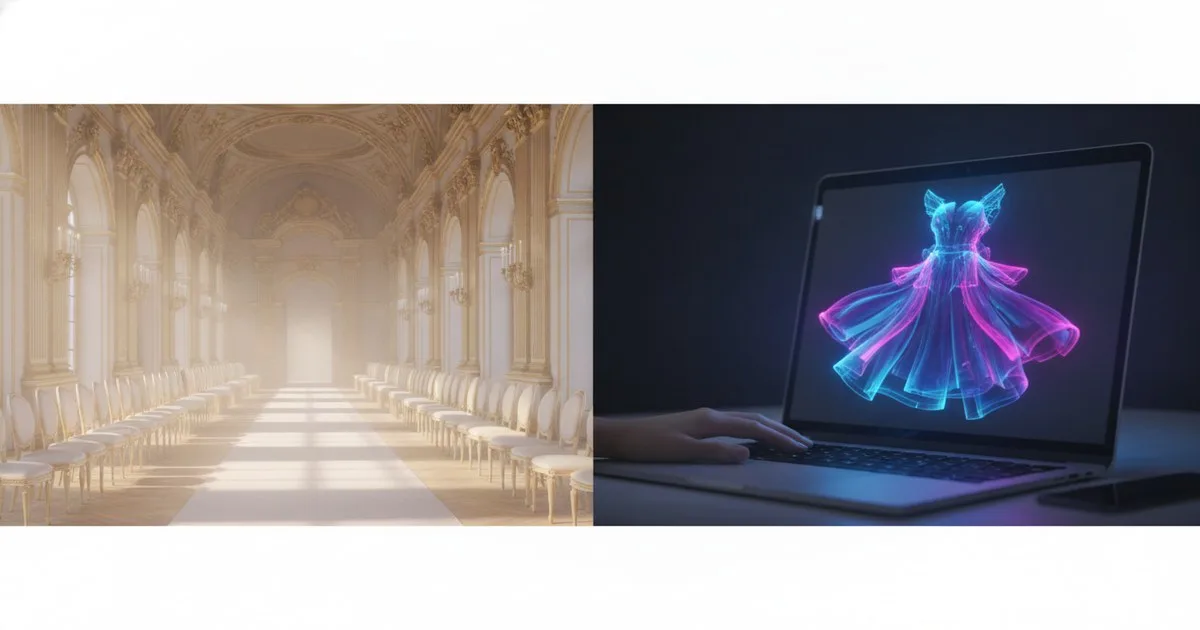
A physical runway show lasts roughly ten minutes. A digital presentation can run for ten seconds or ten hours, depending on who made it and what they wanted to say. When fashion week moved online in earnest, the change was not simply logistical—it touched who gets to watch, how garments are made, what sustainability means in that context, and what the industry loses when there is no room to fill.
If you have ever wondered what actually shifts when a collection goes from a mirrored hall in Paris to a link in your inbox, these seven differences are the clearest place to start.
Key takeaways
- Digital presentations remove the physical guest list, making collections visible to anyone with a connection rather than a few hundred editors and buyers.
- Garments shown digitally can be built entirely in software, meaning a piece of clothing may never be cut from fabric at all.
- The carbon footprint of a show changes shape online—travel and venue emissions fall, but server energy and the environmental cost of digital production rise.
- Real-time interactivity is possible in digital formats in ways a seated runway simply cannot offer.
- The sensory experience of fabric, sound, and atmosphere is genuinely irreplaceable in a physical room—and the industry knows it.
1. Who gets a seat
The guest list expands from hundreds to potentially millions
A physical runway show is, by design, a controlled room. Seats go to editors, buyers, stylists, and a handful of celebrities. The rest of the world reads about it afterward, filtered through whoever was there. A digital presentation dissolves that bottleneck. When a brand streams a show or releases a film, anyone with a link can watch at the same moment as the front row—or weeks later, on their own schedule.
This matters beyond the obvious point about access. It changes who a brand is speaking to. A physical show is a trade event dressed as spectacle; a digital one can be both a trade event and a direct consumer moment simultaneously. Brands we follow have described the tension this creates: the language of a show aimed at buyers is not always the language that moves a general audience, and digital formats force a choice about which conversation to prioritise.
What remains unclear is whether wider reach translates into deeper engagement. Watching a ten-minute film alone on a laptop is a different kind of attention than sitting in a darkened room where the music is physical and the clothes pass close enough to touch.
2. How garments are made—or not made
A digital collection can exist entirely in software
This is the difference that surprises people most. In a physical show, every garment has been cut, sewn, fitted, and pressed. In a digital presentation, a collection can be constructed entirely within 3D software, draped onto a virtual avatar, and rendered without a single needle being threaded. Platforms like Unreal Engine allow designers to build environments and garments with photorealistic fidelity—cloth simulation, light behaviour, and texture all computed rather than constructed.
The implications run in two directions. For emerging designers, it lowers the cost of showing work dramatically: no sample production, no shipping, no fitting rooms. For established houses, it raises a question about authenticity. A gown that has never been worn by a human body, never pulled across a shoulder or caught in a doorway, carries a different kind of truth than one that has.
Some brands use digital tools to prototype and then produce; others show digitally with no intention of making the physical garment at all. The line between a fashion show and a piece of digital art is genuinely blurry here, and not everyone agrees that blurring it is a good thing.
3. The shape of the carbon footprint
Emissions shift rather than disappear
Physical fashion weeks concentrate a remarkable amount of travel into a very short period. Editors, buyers, photographers, and brand teams fly between cities across a month-long circuit. Venues require heating, lighting, and construction. Sets are built and dismantled. The environmental cost is real and has been discussed seriously within the industry for years, with Vogue Business among the publications that have tracked it closely.
Digital presentations remove most of that. But they do not remove all environmental cost. Rendering photorealistic 3D environments at scale is computationally intensive. Streaming video at high resolution consumes server energy. And the production of a polished digital show—with original music, motion capture, and visual effects—can involve its own substantial team of people, some of whom travel. The footprint changes shape rather than vanishing.
The honest position is that digital formats can reduce emissions significantly, particularly by cutting intercontinental travel, but they are not carbon-neutral by default. The reduction depends entirely on how the presentation is made and distributed.
4. The role of the garment itself
Physical clothes carry information that pixels cannot fully replicate
Fabric has weight, drape, and hand—industry words for how a textile falls, moves, and feels against skin. A buyer at a physical show is watching all of that in real time: whether a hem swings correctly, whether a seam lies flat, whether the fabric behaves as the designer intended. These are production signals, not aesthetic ones, and they matter to the people who decide whether to place an order.
Digital presentations, even very good ones, compress this information. Cloth simulation has improved enormously—tools built on engines like Unreal Engine can render convincing movement—but a screen cannot communicate weight or texture the way a body in motion does. Buyers have adapted, using digital shows as a first filter and requesting physical samples before committing. The show is no longer the only moment of evaluation; it is the beginning of a longer conversation.
For consumers, the gap is less consequential. Most people watching a runway show were never going to touch the clothes anyway. But for the trade, the physical show retains a function that digital formats supplement rather than replace.
5. Interactivity and commerce
Digital formats can turn a show into a shopping moment
A physical runway ends and the clothes disappear backstage. If you want to buy something, you wait months for it to reach a store, by which point the cultural moment that made it desirable has often passed. Digital presentations can be built differently. A brand can embed a purchase link directly into a show film, allow viewers to click on a garment as it appears, or connect the presentation to a virtual try-on experience.
This is where companies working in digital fashion infrastructure become relevant. DressX, for instance, has built AI-powered virtual try-on tools that allow shoppers to see how garments look on their own bodies within an e-commerce environment—a capability that connects naturally to the direct-to-consumer ambitions of digital fashion presentations. The logic is straightforward: if you can watch a show and immediately see how a coat would look on you, the distance between desire and purchase shrinks considerably.
Physical shows have never been able to offer this. The runway is a media event, not a retail one. Digital formats blur that boundary deliberately, and some brands find that useful while others resist it, feeling that commerce and presentation belong in separate rooms.
6. Atmosphere and sensory experience
What a screen cannot hold
This is the difference the industry talks about least in public and most in private. A physical show has a specific kind of pressure in the room. The music is loud enough to feel. The lights change the colour of everything. The clothes move past at a pace you cannot control, and the person next to you is reacting in real time. That collective, unrepeatable experience is part of what makes fashion week culturally significant—not just as a trade event but as a social one.
Digital presentations can be beautiful. They can be cinematic in ways a tent in a park cannot match. But they are experienced alone or in small groups, on a device, at a remove. The serendipity of sitting next to someone unexpected, the backstage energy that leaks into the room, the specific acoustics of a particular venue—none of that travels through a screen.
This is not an argument against digital formats. It is simply an honest account of what is lost. The two experiences are not equivalent, and pretending otherwise does not serve anyone trying to understand what the shift actually means.
7. Archival life and longevity
Digital shows exist differently in time
A physical show happens once. There is footage, there are photographs, but the event itself is gone. A digital presentation can be watched again, shared, clipped, and redistributed indefinitely. This changes its relationship to time in ways that are still being worked out.
On one hand, longevity is useful. A designer whose show film is still circulating two years later is still being discovered by new audiences. On the other hand, fashion has always operated on scarcity and novelty—the idea that you had to be there, or that the moment has passed. A show that anyone can watch at any time loses some of that urgency.
There is also a practical dimension. Digital presentations create assets: rendered garments, 3D environments, motion files. These can be repurposed for e-commerce, editorial, and marketing in ways that physical show footage cannot. The show becomes the beginning of a content pipeline rather than a self-contained event. Whether that is a gain or a loss depends on what you think a fashion show is for.
Our guide to using AI image tools to plan outfits before buying touches on how digital garment rendering is beginning to affect the way consumers relate to clothes before they buy them—a shift that connects directly to how digital presentations are changing the relationship between a show and a sale.
FAQ
What is a digital fashion week? A digital fashion week is a season of brand presentations delivered online—through streamed films, 3D-rendered shows, interactive experiences, or social media—rather than in physical venues with a live audience. Formats vary widely by brand.
Do digital fashion shows replace physical ones? Most major brands use both. Physical shows remain the primary format for the largest houses; digital presentations are used alongside them, or by brands for whom the cost of a physical show is prohibitive.
Are clothes in digital fashion shows real? Not always. Some digital presentations show garments that exist only in 3D software and have never been physically produced. Others use digital tools to present real samples that will go into production.
Is a digital fashion show more sustainable than a physical one? It can be, particularly by reducing travel emissions. But digital production has its own energy costs, and the net difference depends on how the show is made and distributed.
Can you buy clothes directly from a digital fashion show? Some brands build purchase links into their digital presentations, and virtual try-on tools are increasingly connected to e-commerce. Physical shows have never offered this kind of direct commerce.
Further reading
- How technology is helping fashion brands connect across distance
- The sustainable and digital transformation of fashion