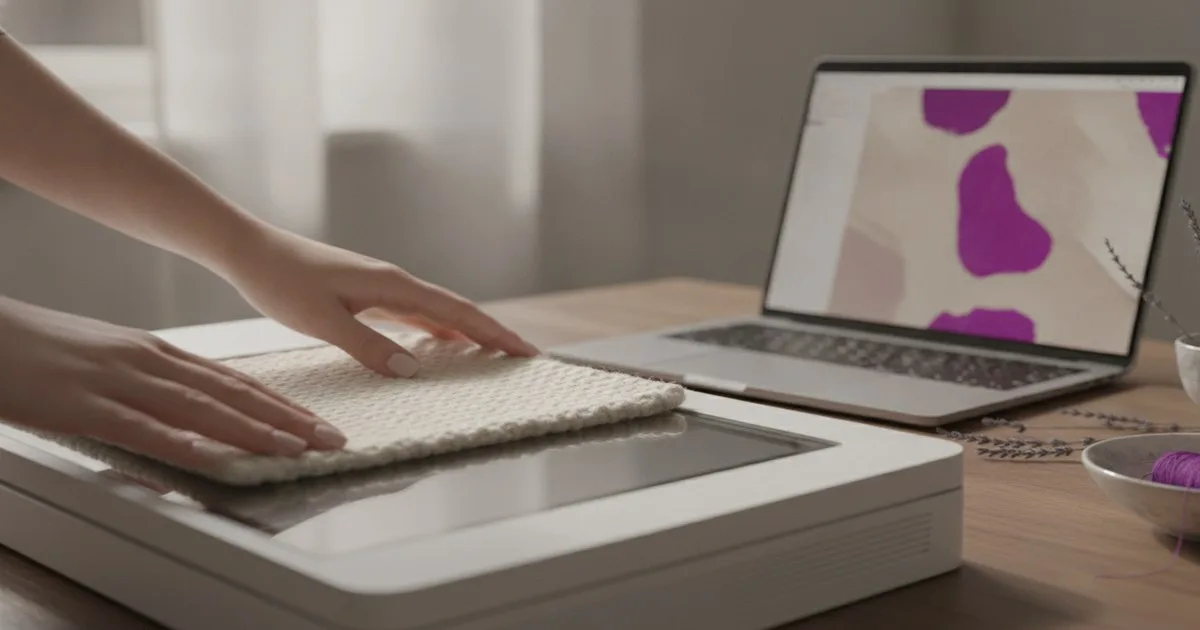
Before a garment can drape convincingly on a digital avatar, or travel from a designer's screen to a factory floor without a single physical sample being shipped across three continents, someone has to teach the software exactly how its fabric moves, stretches, and falls. That process is called fabric digitisation, and it is the quiet, unglamorous prerequisite beneath almost every credible promise fashion technology makes today — from virtual try-on to made-to-order production.
Key takeaways
- Fabric digitisation captures the physical behaviour of a textile — its weight, stretch, drape, and surface texture — and translates that data into a form that 3D software can use.
- Without accurate fabric data, virtual garments look stiff, flat, or simply wrong, which is why virtual try-on tools still disappoint many shoppers.
- Scanning a fabric and simulating it are two distinct steps, each with its own tools and its own margin for error.
- Researchers have found that even experienced designers struggle to judge fabric accurately from a screen alone, which means the quality of digitisation data directly shapes how much designers can trust digital workflows.
- Digital fabric libraries are beginning to replace physical swatch archives, with real consequences for how quickly — and how sustainably — collections can be developed.
What exactly is fabric digitisation?
Fabric digitisation is the process of measuring a physical textile and encoding those measurements as data a computer can use. It has two distinct layers, and conflating them is a common source of confusion.
The first layer is visual capture: photographing or scanning a fabric at high resolution to record its surface colour, sheen, texture, and the way light interacts with its weave or knit structure. The output here is typically a set of image maps — diffuse, normal, roughness, metallic — that together tell a rendering engine how the fabric looks under different lighting conditions.
The second layer is physical property capture: measuring how the fabric actually behaves under force. This means quantifying tensile elongation (how much it stretches along the grain and across it), shear stiffness (how it resists diagonal distortion), bending stiffness (how readily it folds), and specific weight and thickness. These numbers are what allow simulation software to predict how a garment will hang on a body, how a sleeve will fall when an arm is raised, or whether a collar will stand or collapse.
Both layers are necessary. A fabric that looks right but moves wrong is still a failure — and vice versa.
Why does accurate fabric data matter so much?
The short answer is that 3D garment simulation is only as trustworthy as the material data it runs on. If you feed a simulator the wrong bending stiffness for a fabric, the resulting digital prototype will drape differently from the real garment. A designer who approves that digital prototype is approving something that does not exist.
Research published in Fashion and Textiles examined how designers perceive fabrics in digital contexts and found that uncertainty about digital fabric representations leads designers to over-rely on physical samples — which slows the very digital progress the technology is supposed to enable. In other words, poor digitisation data creates a trust deficit that pushes teams back to the physical world.
The stakes are equally high on the consumer side. Virtual try-on tools have grown rapidly, but their credibility depends on how accurately a garment's drape and texture are represented. When the simulation is wrong, the tool feels like a gimmick rather than a useful aid — and shoppers remain sceptical about whether virtual try-on actually works for clothing in particular, even as the technology matures.
How is fabric digitised in practice?
Step 1: Visual scanning
High-resolution flatbed or structured-light scanners capture the fabric's surface at a level of detail the human eye cannot easily distinguish from the real thing. The scanner records how the material reflects light from multiple angles, producing the image maps that rendering engines use.
Vizoo, a Munich-based company, makes the xTex™ system specifically for this purpose — a hardware-and-software combination designed for apparel, footwear, and adjacent industries. Its output integrates directly with major 3D design tools. The company has recently moved into a new phase of growth under a newly appointed chief executive, with a focus on scaling material digitisation across the industry.
Step 2: Physical property measurement
Visual data alone cannot tell a simulator how a fabric moves. Physical properties have to be measured separately, using instruments that apply controlled forces to fabric samples and record how the material responds.
The KES-FB system (Kawabata Evaluation System for Fabrics) is one established laboratory method. A newer approach is the Fabric Kit protocol, which is designed to be faster and more accessible for studio use. The data these instruments produce — tensile elongation in warp and weft, shear stiffness, bending stiffness, weight, thickness — are then imported into simulation software as a material preset.
A peer-reviewed study published in July 2025 tested how well digitised fabric properties translate into accurate 3D simulations by comparing digital prototypes of a blouse and trousers against real garments measured with an optical 3D system. The researchers used data from the KES-FB system, the Fabric Kit protocol, and Seddi Textura to feed simulations in 3D design software, finding average differences between digital and real prototype deformation within a measurable range — promising, but a reminder that the gap between digital and physical has not yet closed entirely.
Step 3: Simulation and validation
Seddi operates Textura.ai, a cloud-based platform for generating 3D digital textiles. It sits at the simulation end of the workflow, taking physical fabric data and producing material presets that designers can apply to digital garments. Seddi also ships Decorator™, a 3D visual workspace for branded apparel that creates digital replicas of real blank garments for client proofing and production instructions — a signal of where the technology is heading: not just visualisation, but the full approval-to-production chain.
What is a digital fabric library, and why does it matter?
Once a fabric has been digitised, its data can be stored and reused. A digital fabric library is a collection of these material records — visual maps, physical properties, supplier metadata — organised so that designers can browse, search, and apply them without handling a physical swatch.
The practical implications are significant. Sending physical swatches between mills, design studios, and production partners is slow, expensive, and wasteful. A digital library means a designer in London can evaluate a Japanese mill's new season fabrics without waiting for a courier. It also means that a fabric approved for one collection can be reused in future seasons without re-scanning.
Frontier.cool ships TextileCloud™, an AI-powered enterprise materials management platform that digitises physical fabrics into 3D texture maps and physics data, then organises them into searchable cloud libraries with tools for palette creation, vendor collaboration, and integration with 3D design environments. It is designed for brands that want to replace or supplement a physical swatch archive with a living digital one.
Swatchbook, now part of CLO Virtual Fashion following its acquisition in 2025, operates as a cloud-based platform for sourcing, managing, and visualising digital materials — connecting brands, designers, and suppliers through a shared material marketplace. As part of CLO Virtual Fashion's ecosystem, it is positioned to become one of the larger fabric databases in the industry.
What is still unsolved?
Fabric digitisation has made real progress, but several problems remain genuinely open.
The trust gap. Even when digital fabric data is accurate, designers may not feel confident acting on it. The research in Fashion and Textiles found that uncertainty about digital representations leads to over-reliance on physical samples. Closing this gap requires not just better data but better interfaces — ways of presenting fabric behaviour on screen that feel intuitive rather than abstract.
Knits and stretch fabrics. Woven fabrics with relatively predictable mechanical behaviour are easier to digitise than knits, which stretch in complex, non-linear ways. Simulation accuracy for stretch fabrics remains lower, which is one reason virtual try-on tools tend to perform better for structured garments than for jersey or knitwear.
Finish and ageing. A fabric's behaviour changes when it is washed, worn, or treated with a finish. Current digitisation captures the fabric at a single moment — typically off the roll — and does not model how it will change over time. A linen that softens dramatically after washing, or a coating that cracks, is not yet something a digital library can represent.
Standardisation. Different scanning systems and measurement protocols produce data in different formats. A material digitised on one system may not transfer cleanly to a different design tool without manual adjustment. Industry-wide standards for fabric data formats would accelerate adoption, but they do not yet exist in a widely agreed form.
What does this mean for sustainability?
The connection between fabric digitisation and sustainability is more direct than it might appear. Physical sampling — sending fabric swatches and garment prototypes back and forth between design studios, mills, and factories — generates significant waste and carbon emissions. Every physical sample that a credible digital equivalent can replace is a small reduction in that footprint.
Brands that build robust digital fabric libraries can also make sourcing decisions earlier in the development cycle, when it is still possible to choose lower-impact materials without disrupting production schedules. And when a digital prototype is accurate enough to go directly to production approval, the number of physical samples a collection requires drops substantially.
None of this eliminates physical sampling entirely — at least not yet. But the direction of travel is clear, and fabric digitisation is the part of the workflow that makes the rest of it credible.
FAQ
What is fabric digitisation in simple terms? It is the process of measuring a physical textile — how it looks, how heavy it is, how it stretches and bends — and saving those measurements as data that 3D design software can use to simulate how a garment will actually behave.
Why do virtual try-on tools sometimes look unconvincing? Often because the fabric data behind the simulation is incomplete or inaccurate. If a software tool does not know how stiff or how heavy a fabric is, the digital garment will drape differently from the real one — and the result looks wrong to anyone who has worn real clothes.
What is the difference between a visual scan and a physical property measurement? A visual scan records how a fabric looks — its colour, texture, and surface detail. A physical property measurement records how it moves — its stretch, stiffness, and weight. Both are needed for a convincing simulation; one without the other produces a result that is either visually accurate but physically wrong, or vice versa.
Can a digital fabric library replace a physical swatch archive? For many purposes, yes — especially for early-stage design decisions and supplier evaluation. Physical samples are still needed for final approval and production sign-off in most workflows, but the number required can be reduced significantly when digital data is accurate and trusted.
How does fabric digitisation help with sustainability? By reducing the need to produce and ship physical fabric samples and garment prototypes across the supply chain. Fewer physical samples means less material waste and lower transport emissions during the development process.
Further reading
- Analysis of woven fabric mechanical properties in digital simulation contexts
- Fabric perceptions in digital contexts: certainty and accuracy