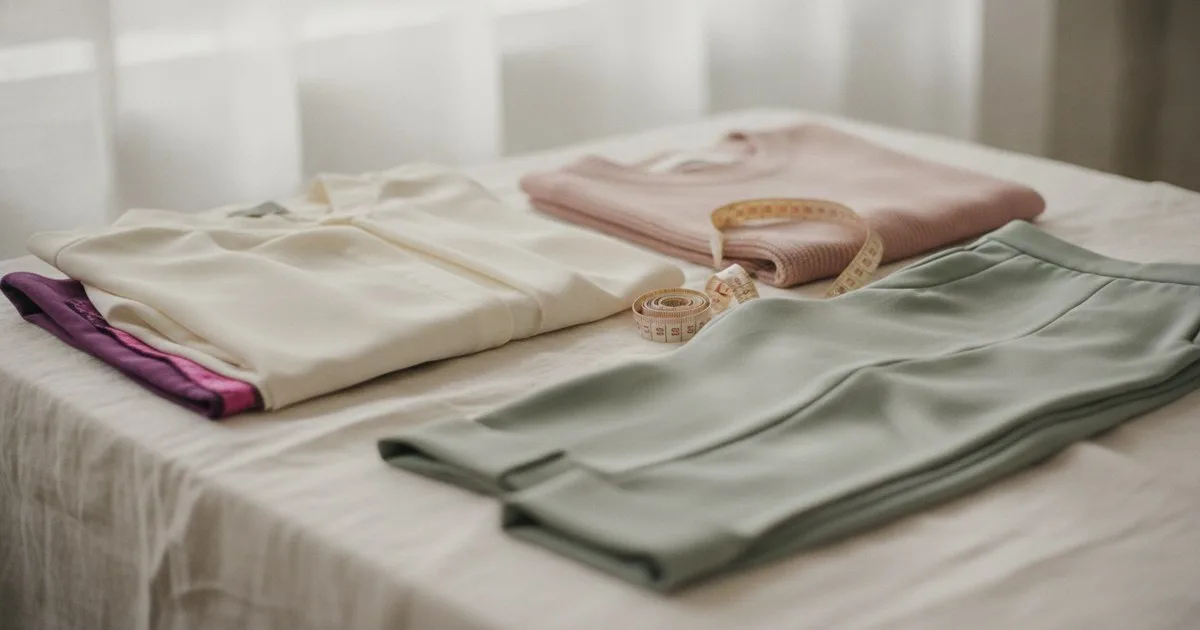
You filled in your height, weight, and chest measurement. You answered questions about whether you like a relaxed or fitted feel. The algorithm promised a size, you ordered it, and three days later you were folding it back into the bag. This is not a failure of effort on your part — it is a structural problem with how sizing works, and no quiz, however clever, has fully solved it yet.
Key takeaways
- The human body does not conform to standard sizing grids: research published in Scientific Reports found that more than 90% of study participants showed size variation across bust, waist, and hip measurements, meaning a single size label rarely fits all three dimensions at once.
- Fit algorithms are only as good as the garment data brands share with them — and that data is often incomplete or inconsistent across brands.
- Fabric, construction, and the way a garment is photographed all affect how something fits, and none of those factors appear in a size quiz.
- Clothing returns carry a real environmental cost: the European Environment Agency estimates that roughly one third of all returned clothing bought online ends up destroyed.
- Smarter fit tools are getting better — but the gap between a recommendation and a perfect fit is still wide enough to matter.
What does an AI fit quiz actually do?
When you complete a size quiz on a retailer's website, you are feeding a model. That model has been trained on a combination of things: the measurements brands attach to their garments, purchase and return data from previous shoppers, and sometimes body-measurement data collected from users who have opted in over time.
The algorithm looks at what you have told it about your body, matches it against what it knows about how other shoppers with similar profiles behaved, and returns a recommendation. It is less like a tailor measuring you in a fitting room and more like a very well-informed guess based on patterns in a large dataset.
Some tools go further. Bold Metrics builds what it calls a digital twin — a model of your body that maps more than 50 measurements from a handful of inputs — and uses that to predict not just a size but how specific garments will sit on your specific proportions. True Fit draws on a network of purchase and return signals across many brands and retailers, so its recommendations are informed by how real shoppers with your profile have responded to particular garments in the past. Fit Analytics, now part of Snap Inc. after its acquisition in 2021, operates its Fit Finder recommendation tool within Snap's commerce stack, contributing sizing intelligence to the broader ecosystem.
These are genuinely useful tools. They reduce returns at scale and help shoppers avoid obvious mismatches. But there is a gap between reducing returns and eliminating them — and understanding that gap is worth your time.
Why does the human body defeat standard sizing?
The core problem is not the algorithm. It is the sizing grid underneath it.
Standard clothing sizes were built on the assumption that bodies follow predictable proportions — that if your bust is a certain measurement, your waist and hips will fall within a predictable range. They do not. Research published in Scientific Reports, drawing on a dataset of 677 participants measured via 3D body scanning, found that only about 9% of participants showed consistent sizing across bust, waist, and hip measurements. More than a third were not adequately accommodated by the existing sizing scheme at all.
This means that when a brand designs a size 12, it is designing for a statistical average that most actual size-12 bodies only partially resemble. A fit algorithm can tell you which size is closest to your measurements, but it cannot change the fact that the garment was not designed for the full range of bodies that will try to wear it.
Add to this the fact that sizing is not standardised across brands — a 12 at one label is a 14 at another, and a medium in one country is a small in the next — and you have a system where even a highly accurate recommendation is working against structural inconsistency.
What the quiz cannot see
Even the most sophisticated fit quiz is working with incomplete information. Here is what it typically cannot account for:
Fabric and construction. A jersey knit behaves completely differently from a woven cotton or a structured denim. The same size in two different fabrics will drape, stretch, and compress in ways that a measurement-based model cannot fully predict without detailed garment-level data — data that brands do not always share, or do not always have in a structured form.
Ease and design intent. A garment's fit depends on how much ease — the extra room built in beyond the body measurement — the designer intended. An oversized silhouette and a tailored blazer might share a size label but have entirely different relationships to your body. Fit algorithms increasingly try to capture this through style tags and fit descriptors, but the translation from design intent to data is imperfect.
Posture and proportion. Your height and weight tell the algorithm something, but they do not tell it about your torso length, your shoulder slope, or whether your hips sit high or low. These are the details a tailor notices in the first thirty seconds of a fitting. They are very hard to capture in a four-question quiz.
How the garment was photographed. Product photography is styled. Clothes are pinned, clipped, and lit to look their best. The visual impression you form before you buy is part of what creates the expectation — and when the garment arrives, the reality of fabric and construction can feel quite different from what the image suggested.
What happens to the clothes that come back?
Returns are not just an inconvenience. They carry weight — literally and environmentally. The European Environment Agency has estimated that the average return rate for clothing bought online in Europe is around 20%, and that roughly one third of those returned garments end up destroyed rather than resold.
In the United States, the scale is different but the problem is comparable. Total retail returns — across all categories — are projected to reach $849.9 billion in 2025, according to the National Retail Federation. Apparel is among the highest-return categories, and fit is consistently cited as the primary reason.
This is part of why the fit-technology sector has attracted sustained attention. Better recommendations mean fewer returns, which means less waste, lower logistics costs, and — in theory — a more sustainable relationship between what gets made and what gets kept.
Are the tools getting better?
Yes, meaningfully so. The direction of travel is toward richer data on both sides of the equation: more precise body data from shoppers, and more detailed garment data from brands.
Bold Metrics is moving beyond size recommendations toward helping brands use aggregated body data to inform design and fit decisions upstream — so that future garments are cut for the actual bodies buying them, not for a statistical average from decades ago. True Fit is expanding into what it describes as agentic shopping infrastructure, positioning its fit and preference data as a layer that AI shopping assistants can call on when making recommendations across platforms.
Zalando, one of Europe's largest fashion platforms, has been developing its own AI capabilities — including work on personalisation and fit — as part of a broader push toward making its platform more responsive to individual shoppers at scale.
The honest answer, though, is that no tool currently closes the gap entirely. The best recommendations reduce the probability of a bad fit; they do not eliminate it. And until garments are cut with greater variety in proportion — or until made-to-order production becomes accessible at a broader price point — there will always be a distance between the size on the label and the shape of the person wearing it.
What can you do in the meantime?
Knowing the limits of fit algorithms does not mean ignoring them. It means using them as one input rather than a final answer.
- Take your own measurements before you shop, not just your weight. Bust, waist, hip, and inseam give an algorithm more to work with and give you a better sense of where you sit on any brand's size chart.
- Read the size chart for that specific brand, not the one you remember from last time. Sizing varies significantly across labels, and the algorithm is only as accurate as the data it has been given.
- Look for garment-level fit notes — descriptions that tell you whether a style runs large, whether it is designed with extra ease, or whether the fabric has stretch. This is the kind of information that closes the gap between a measurement and a real-world fit.
- Check the return policy before you buy, especially for a new brand. Knowing you have a straightforward route back reduces the cost of experimenting.
- Give feedback when tools ask for it. The networks that power fit recommendations — including True Fit's — improve when shoppers report what worked and what did not. Your return data is, in a quiet way, training the next recommendation.
FAQ
Why does an AI fit quiz get my size wrong if I enter accurate measurements? Your measurements describe your body, but the garment was designed for a statistical average. Fabric behaviour, design ease, and proportion differences between bodies mean that even a precise measurement match does not guarantee a comfortable fit.
Is fit technology actually reducing returns? Brands that deploy fit recommendation tools generally report lower return rates compared to shoppers who do not use them. But returns from fit issues have not been eliminated — the tools narrow the gap rather than close it.
What is a digital twin in the context of clothing fit? In fit technology, a digital twin is a detailed model of your body — typically mapping many more measurements than you would enter manually — used to predict how specific garments will sit on your proportions. Bold Metrics uses this approach to go beyond a single size recommendation.
Does it matter which fit tool a retailer uses? Somewhat. Tools differ in how much garment data they have access to and how they model the relationship between body shape and fit. A tool with richer data from a specific brand will tend to give more accurate recommendations for that brand's garments.
Will made-to-order clothing solve the sizing problem? Made-to-order production — where a garment is cut to your measurements — addresses the core issue directly. The constraint is cost and lead time. As production technology develops, the economics may shift, but for most shoppers, made-to-order remains a premium option rather than an everyday one.
Further reading
- Evaluating machine learning models for clothing size prediction using anthropometric measurements from 3D body scanning — Scientific Reports
- The destruction of returned and unsold textiles in Europe's circular economy — European Environment Agency
- 2025 Retail Returns Landscape — National Retail Federation