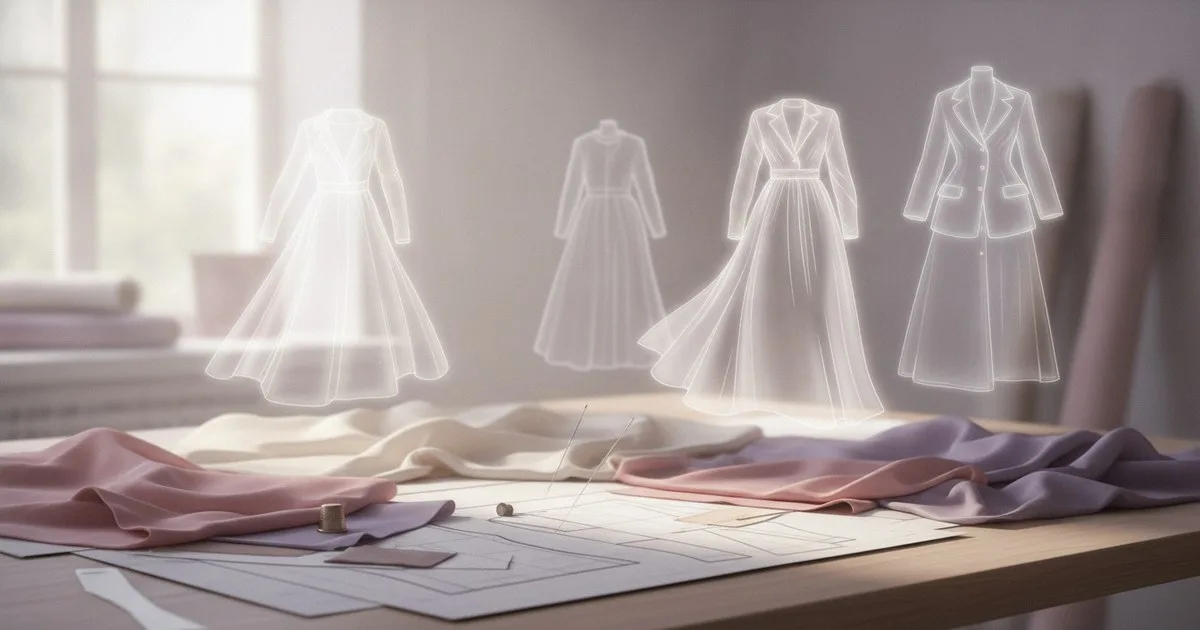
The clothes you buy today were almost certainly shaped by software you have never heard of. Long before generative AI entered the conversation, fashion studios were already running garments through physics engines, grading patterns on digital tables, and arguing about whether a render could replace a muslin. The story of AI and 3D in fashion is not a sudden revolution—it is a slow accumulation of tools, experiments, collapses, and quiet reinventions that stretches back several decades.
Key takeaways
- 3D garment simulation began in research labs and game engines before fashion brands adopted it as a sampling tool.
- The first wave of digital fashion tools focused on pattern CAD and marker-making; the current wave adds AI-driven fit, trend forecasting, and generative imagery.
- A digital dress sold on the blockchain in 2019 signalled that fashion's relationship with the virtual was becoming commercial, not just technical.
- Sustainability claims around digital sampling are real but partial—reduced physical samples do not automatically mean lower overall emissions.
- Intellectual property law has not caught up with AI-generated design, leaving brands and creators in genuine legal uncertainty.
Where did it all begin?
The earliest digital tools in fashion were not glamorous. They were pattern-grading programs running on workstations in cut-and-sew factories, built to solve a practical problem: scaling a base pattern up and down through a size range without a human redrawing every seam. By the 1980s and 1990s, CAD systems for pattern-making were already common in large apparel manufacturers, and marker-making software—which calculates how to nest pattern pieces on fabric to minimise waste—was considered a genuine efficiency gain.
These tools were invisible to consumers and largely invisible to the fashion press. They lived in production departments, not design studios. But they established something important: the idea that a garment could exist as data before it existed as cloth.
When did 3D simulation enter the picture?
Physics-based cloth simulation had a longer life in film and games than in fashion. Visual effects studios were draping digital capes over digital characters years before a clothing brand thought to use the same mathematics to check whether a jacket collar would lie flat. The crossover happened gradually, as researchers and startups began adapting simulation engines specifically for the constraints of real garment construction—seam allowances, grain lines, stretch ratios, the particular way woven versus knit fabrics behave under tension.
Browzwear was among the companies that made this crossover practical for fashion professionals. Its VStitcher platform uses physics-based simulation to let designers build a garment from pattern pieces, assign fabric properties, and watch it drape on a virtual body—catching fit problems before a single metre of sample fabric is cut. Today, Browzwear's platform extends from that simulation core to AI-driven fit validation, on-model imagery, and connectivity with PLM and ERP systems, compressing the gap between design approval and factory floor.
A peer-reviewed study published in the International Journal of Fashion Design, Technology and Education examined how PLM and 3D visualisation tools could reduce the environmental footprint of fashion supply chains, finding genuine potential—but also noting that realising it required coordination across supply chain partners, not just software adoption by a single brand. That caveat matters: the sustainability case for 3D sampling is real, but it depends on how broadly a brand actually replaces physical prototypes rather than running digital and physical processes in parallel.
What changed when AI arrived?
The word "AI" covers several distinct things in fashion, and the history of each is different.
Trend forecasting was one of the first areas where machine learning found a foothold. Analysing social-image data at scale—tracking which silhouettes, colours, and details were gaining visual traction across platforms—turned out to be a tractable problem for computer vision. Heuritech built a business around exactly this, using image recognition to surface trend signals from social media for fashion brands. The company was acquired by Luxurynsight in late 2024 and now operates as part of that firm's luxury data-intelligence platform, with its forecasting signals integrated into a broader market-intelligence suite.
Fit and size recommendation attracted a different kind of investment. The problem—predicting whether a garment will fit a specific body before it is purchased—is both commercially valuable (returns are expensive) and technically hard (bodies are not standard, and neither are garments). Several companies built recommendation engines; some were absorbed into larger platforms. Fit Analytics, for instance, became part of Snap Inc. after an acquisition, with its sizing capability folded into Snap's commerce and augmented-reality stack.
Generative imagery arrived later and changed the conversation most visibly. Tools capable of producing photorealistic images from text prompts—DALL-E, now at version 3 and part of OpenAI's product suite, among others—gave designers and brands a way to visualise concepts without a photoshoot or a physical sample. The implications for fashion marketing, lookbook production, and early-stage ideation were immediate and still unfolding.
What was the moment digital fashion became a cultural object?
In 2019, Dutch studio The Fabricant, working with Dapper Labs and artist Johanna Jaskowska, sold a digital dress called Iridescence for $9,500 on the blockchain. The dress existed only as a file; the buyer received a garment tailored to their image, unique by virtue of its blockchain record. It was not a stunt, exactly—it was a proof of concept that digital fashion could carry monetary and cultural value independent of any physical object.
That moment opened a door. DressX walked through it and built a business on the other side. Today DressX operates an enterprise AI suite for fashion and luxury brands, centred on photorealistic virtual try-on integrated into e-commerce product pages. The company is building persistent shopper memory—size and style preferences that travel with a customer—into its system, positioning virtual try-on not as a novelty but as core merchandising infrastructure.
Did automation deliver on its promises?
Not always, and the fashion industry's experience mirrors the broader pattern of automation hype followed by friction. Adidas opened robotic "Speedfactories" in Germany and the United States as part of a strategy to decentralise manufacturing and produce shoes closer to the consumer. By late 2019, the company announced it was closing both facilities, citing the limitations of the technology for its existing product range and redirecting the approach toward its human-powered factories in Asia. The episode was a useful reminder that automation in fashion is not a single unlock—it is a set of specific capabilities, each of which fits some production contexts and not others.
Job displacement is the harder conversation. When a brand replaces ten rounds of physical sampling with two, the pattern-makers and sample machinists who would have made those samples are affected. The industry tends to frame this as "efficiency"; the workers who absorb the change experience it differently. Digital tools have created new roles—3D technical designers, digital asset managers, AI prompt specialists—but the transition is not seamless, and the new roles do not always land in the same communities as the ones they replace.
What is the intellectual property problem?
Generative AI trained on existing imagery raises a question that fashion has not resolved: who owns a design produced by a model trained, in part, on the work of human designers? The U.S. Copyright Office has been working through this in stages. Its ongoing report on copyright and artificial intelligence—with parts published across 2024 and into 2025—addresses the copyrightability of AI-generated outputs and the question of digital replicas, but stops short of providing the clear framework that brands and creators need. The short answer, for now, is that purely AI-generated work with no meaningful human authorship is unlikely to receive copyright protection in the United States, but the line between "AI-assisted" and "AI-generated" is genuinely contested.
For fashion brands, this creates practical uncertainty. A design developed with generative tools may be harder to protect than one drawn by hand. A brand's visual identity—its signature silhouettes, its archive of prints—could theoretically be reproduced by a model trained on public imagery. Neither problem is hypothetical; both are being litigated and lobbied over in real time.
Where does the technology stand today?
The current moment in AI and 3D fashion is characterised less by a single breakthrough than by the integration of tools that previously existed in separate silos. 3D simulation platforms now connect to PLM systems, which connect to supplier portals, which connect to e-commerce. Trend forecasting feeds into range planning. Virtual try-on sits inside product pages. The garment that once moved through a linear pipeline—sketch, pattern, sample, photograph, sell—now moves through a network of digital touchpoints, each generating data that feeds back into the next cycle.
That integration is genuinely useful. It is also genuinely complex to implement, and the brands that benefit most are those with the resources to manage the change—which tends to mean large enterprises rather than independent designers. The technology is becoming more accessible, but the gap between what a well-resourced brand can do with these tools and what a small studio can do remains wide.
Sustainability claims deserve the same careful reading they always have. Fewer physical samples is a real reduction in material waste and shipping emissions. But a brand that adds a digital workflow on top of an unchanged physical process has not reduced its footprint—it has added to it. The honest version of the sustainability story is that 3D and AI tools create the possibility of a lighter process; realising that possibility requires deliberate choices, not just software licences.
FAQ
What is 3D fashion design and how does it differ from traditional pattern-making? Traditional pattern-making produces flat paper or digital templates that are cut from fabric and sewn into a physical sample. 3D fashion design uses physics-based simulation to assemble those same pattern pieces on a virtual body, showing how the garment drapes and fits without cutting a single piece of cloth.
When did AI start being used in fashion? Machine learning entered fashion gradually, with early applications in trend forecasting and demand prediction appearing in the mid-2010s. Generative AI tools capable of producing design imagery became widely available to brands in the early 2020s, though research-stage work predates that by several years.
Can AI design clothes on its own? Current AI tools can generate imagery, suggest colourways, and produce pattern variations, but producing a production-ready garment still requires human technical expertise. The U.S. Copyright Office has also indicated that purely AI-generated work is unlikely to receive copyright protection, which gives brands an additional reason to keep human designers meaningfully involved.
Does digital sampling actually reduce fashion's environmental impact? It can, but only if brands genuinely replace physical samples rather than running both processes simultaneously. A digital workflow that sits alongside an unchanged physical one adds cost and complexity without reducing material waste or shipping emissions.
What happened to the idea of digital-only fashion? It did not disappear—it evolved. What began as a blockchain experiment with a single digital dress has grown into an enterprise category, with platforms offering virtual try-on integrated into mainstream e-commerce. The idea that a garment can have value without existing physically is now a commercial reality, not just a concept.
Who owns a design made with generative AI? This is genuinely unresolved. The U.S. Copyright Office's ongoing analysis suggests that AI-generated outputs without meaningful human authorship are unlikely to receive copyright protection, but the boundary between AI-assisted and AI-generated work is still being defined through policy and case law.
Further reading
- A digital dress sold for $9,500 — Engadget
- Copyright and Artificial Intelligence — U.S. Copyright Office
- Should the fashion industry confront the sustainability challenge with 3D tools? — International Journal of Fashion Design, Technology and Education