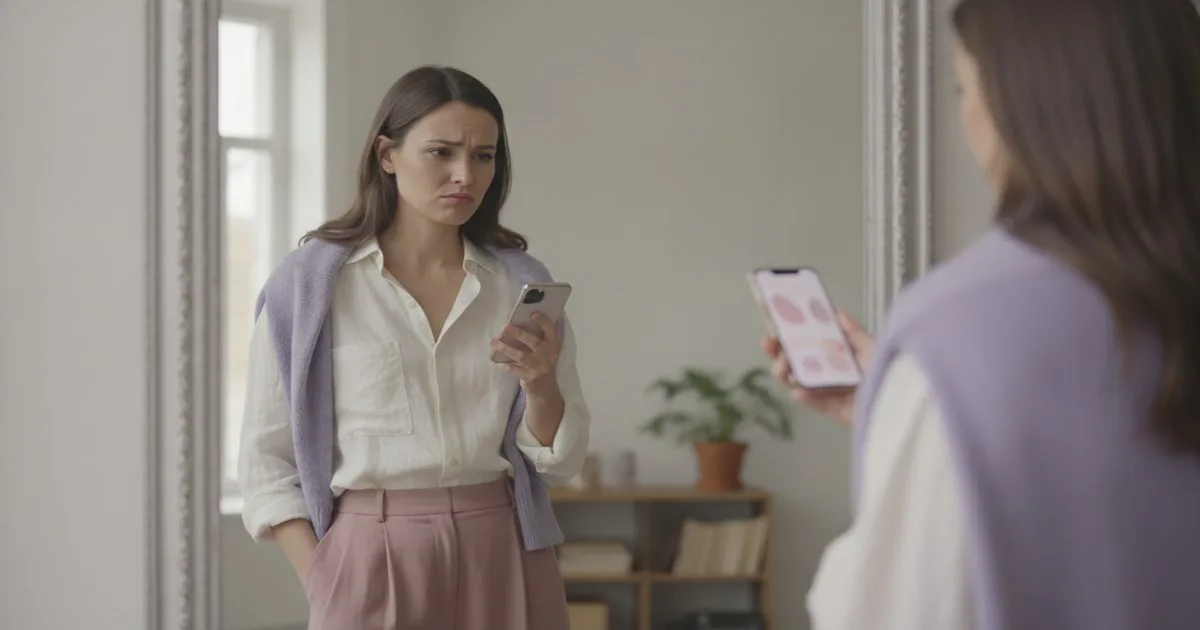
Virtual try-on has become one of the most visible promises in online shopping: upload a photo, see the dress on your body, buy with confidence. The idea is appealing, and the technology behind it has improved considerably. But the gap between what these tools show you and what you actually need to know before committing to a purchase is wider than most retailers admit. Understanding that gap is the most useful thing you can do before you click.
Key takeaways
- Virtual try-on tools are good at showing colour, pattern placement, and a garment's general silhouette—but they are not designed to predict how fabric will drape on your specific body.
- Most current systems default to making clothes look well-fitted regardless of whether they actually are, because the underlying models are trained almost entirely on well-fitted examples.
- Body proportion—the relationship between your torso length, shoulder width, and hip-to-waist ratio—is rarely captured accurately by a single selfie.
- Fit recommendation tools that draw on your stated measurements offer a different, and often more reliable, kind of information than visual try-on.
- Returns remain a significant problem across the industry, which means the technology's limits have real financial and environmental consequences.
What does virtual try-on actually do?
At its core, a virtual try-on tool takes an image of a garment and an image of a person—either a stock model or a photo you upload—and composites them together using machine learning. The system estimates where your shoulders, waist, and hips sit, then warps the garment image to fit those landmarks.
Google's virtual try-on feature, built into Google Search and Google Shopping, works by rendering apparel items across a range of real models so that shoppers can see how a piece looks on different body types before visiting a retailer's site. The approach is honest about one of the technology's core challenges: as Google noted when the feature launched, forty-two percent of online shoppers don't feel represented by standard model imagery, and fifty-nine percent have felt disappointed when an item looked different on them than expected online. Virtual try-on was designed to address exactly that frustration.
Veesual takes a related approach for e-commerce brands, automatically converting static product visuals into short videos at scale by connecting to a brand's product feed—giving shoppers a sense of movement and drape that a still image cannot convey.
Both approaches are genuinely useful. Neither is a substitute for a fitting room.
Where the technology is strong
Before cataloguing the limits, it is worth being fair about what virtual try-on does well.
Colour and print accuracy. If you are trying to decide between a dusty rose and a terracotta, or you want to see how a bold floral print will read at scale on your frame, a good virtual try-on tool gives you a reasonable answer. The garment's surface appearance—its colour, its graphic, its texture at a distance—is the part of the image that the AI handles most reliably.
General silhouette. You can usually tell from a virtual try-on whether a style is cropped or long, fitted or voluminous, whether a neckline sits high or low. These are broad shape questions, and the technology answers them adequately.
Representation across body types. This is where the category has made its most meaningful progress. Seeing a garment on a model whose proportions are closer to yours is more useful than seeing it only on a narrow range of sample sizes. Tools that offer multiple model options address a real gap in traditional product photography.
Where virtual try-on quietly fails
Fabric drape
Drape is the way a fabric falls and moves under gravity. A silk charmeuse slip dress behaves entirely differently from a cotton poplin shirt-dress, even if they share the same silhouette. A bias-cut skirt clings and swings; a structured brocade holds its shape. These differences are the difference between a garment that flatters and one that does not.
Current virtual try-on systems render a garment's texture visually, but they cannot simulate how that specific fabric will behave on your body in motion. The image you see is essentially a static composite. What you cannot see is whether the fabric will pull across your hips when you sit, or whether the hem will hang evenly given the way your weight is distributed.
True fit versus visual fit
This is the most significant limit, and it is one that researchers are actively working to address. A paper published on arXiv examining fit-aware virtual try-on found that current methods default to generating well-fitted results regardless of the actual garment or person size, because the datasets used to train these models contain almost no examples of genuinely ill-fitting garments. The system has learned to make everything look right, which means it will show you an extra-large shirt looking neatly fitted on a petite frame—even when, in reality, it would swamp you.
This is not a minor quirk. It means the visual output of a try-on tool is systematically optimistic about fit in a way that is invisible to the shopper.
Body proportion
A single front-facing photo captures very little of the information that determines how a garment will fit. It cannot tell the system your back length, your posture, how high or low you carry weight, or the relationship between your shoulder width and your chest measurement. A dress that looks perfectly proportioned on a model with a long torso will hit at a completely different point on someone with a short one—and a virtual try-on tool, working from a selfie, cannot account for that.
Fabric hand and weight
Nothing in a virtual try-on tells you whether a fabric is stiff or fluid, scratchy or soft, heavy or weightless. These qualities determine comfort and wearability in a way that no image can communicate. A linen blazer and a polyester blazer can look nearly identical on screen and feel completely different on your body.
What fit recommendation tools do differently
Fit recommendation technology works from a different starting point. Rather than compositing images, tools like True Fit build a model of your size and fit preferences from your measurements, your purchase history, and data about how garments from specific brands actually fit across a large population of wearers. The output is not a picture—it is a size recommendation and a confidence level.
This approach addresses a different question: not "what will this look like on me" but "what size should I order from this brand, given how their garments are cut." For many shoppers, that second question is the more useful one.
3DLOOK takes the measurement side further, using two smartphone photos to extract a detailed set of body measurements—a method that gives a garment's size recommendation a more precise physical foundation than self-reported measurements alone.
Neither approach replaces the other. Visual try-on and fit recommendation tools answer different questions, and the most useful shopping experience would use both.
The returns problem behind the technology
The stakes here are not trivial. Total retail returns are projected to reach $849.9 billion in 2025, according to research from the National Retail Federation and Happy Returns. Fit and appearance disappointment are among the leading drivers of fashion returns. A technology that makes clothes look better than they will feel is not solving that problem—it may be compounding it.
There is also an environmental dimension. Every returned parcel has a carbon footprint: the outbound shipment, the return journey, the reprocessing. If virtual try-on tools increase purchase confidence without actually improving fit accuracy, the sustainability gains are largely illusory. Technologies that reduce returns—rather than simply increasing conversion—are the ones that will matter over time. Body measurement and 3D virtual sampling approaches are among the methods being explored as more substantive alternatives.
A note on privacy
When you upload a photo of yourself to a virtual try-on tool, you are sharing biometric data. The legal landscape around this is still developing. Bloomberg Law has reported on the growth of biometric privacy lawsuits against retailers offering virtual try-on for glasses and cosmetics, noting the novel legal questions these cases raise. It is worth reading a retailer's privacy policy before uploading your image, and checking whether your data is stored, shared, or used to train future models.
How to shop more carefully with these tools
None of this means virtual try-on is useless. It means using it with clear eyes about what it can and cannot tell you.
- Use it for colour and print decisions. This is where it is most reliable. If you are choosing between two colourways, the visual output is genuinely informative.
- Cross-reference with a fit tool. If the retailer offers a size recommendation feature, use it alongside the visual try-on rather than instead of it.
- Read the size chart carefully. Check the brand's specific measurements against your own, not just the label size. Sizing varies significantly between brands and even between product lines within the same brand.
- Look for fabric content and weight information. A garment description that tells you the fabric weight in grams per square metre, or describes the hand of the fabric, is giving you information the try-on image cannot.
- Check the return policy before you buy. Given the limits of the technology, a generous return window is part of the value proposition of shopping online.
- Look for customer photos and reviews. Real shoppers photographed in real light, describing how a garment actually fits, remain among the most reliable sources of information available.
What is coming next
Researchers are working on fit-aware virtual try-on that would actually simulate ill-fitting results—showing you how a garment looks when it is too large or too small, rather than defaulting to a flattering composite. The arXiv paper cited above is part of that effort, building datasets that include genuine fit variation rather than only well-fitted examples.
The integration of more precise body measurement into visual try-on pipelines is another direction the field is moving. If a tool knows your actual measurements—not just your approximate silhouette from a selfie—it can render a more accurate result. Whether that accuracy will extend to drape and fabric behaviour is a harder problem, and one that the industry has not yet solved.
For now, the most honest thing a virtual try-on tool can do is show you how a garment looks on a body that resembles yours—and the most honest thing you can do as a shopper is remember that looking and fitting are not the same thing.
FAQ
Can virtual try-on tell me if something will fit? Not reliably. Most tools show you how a garment looks visually, but they are trained to make clothes appear well-fitted regardless of actual size. A separate fit recommendation tool that uses your measurements gives you more accurate sizing guidance.
Why do clothes look different when they arrive than in the virtual try-on? Virtual try-on composites a garment image onto your photo—it cannot simulate how the actual fabric drapes, stretches, or behaves under gravity. The difference between the screen and reality is largely a fabric and fit question the technology cannot yet answer.
Is it safe to upload my photo to a virtual try-on tool? Your photo may constitute biometric data under some privacy laws. Before uploading, check the retailer's privacy policy to understand how your image is stored and whether it is used to train AI models.
What is the most reliable way to get the right size online? Combine the brand's size chart with your own measurements, use a fit recommendation tool if one is available, and read customer reviews from people with similar proportions. Virtual try-on can help with colour and silhouette decisions but is less reliable for size.
Will virtual try-on technology improve? Researchers are developing fit-aware models that simulate ill-fitting results rather than defaulting to flattering composites, and more precise body measurement is being integrated into visual pipelines. Meaningful improvement is likely, but the fabric drape problem remains genuinely difficult.
Does virtual try-on reduce returns? The evidence is mixed. Tools that improve colour and silhouette confidence may reduce some returns, but if the technology systematically makes clothes look better than they fit, it may not reduce fit-related returns—which are among the most common.