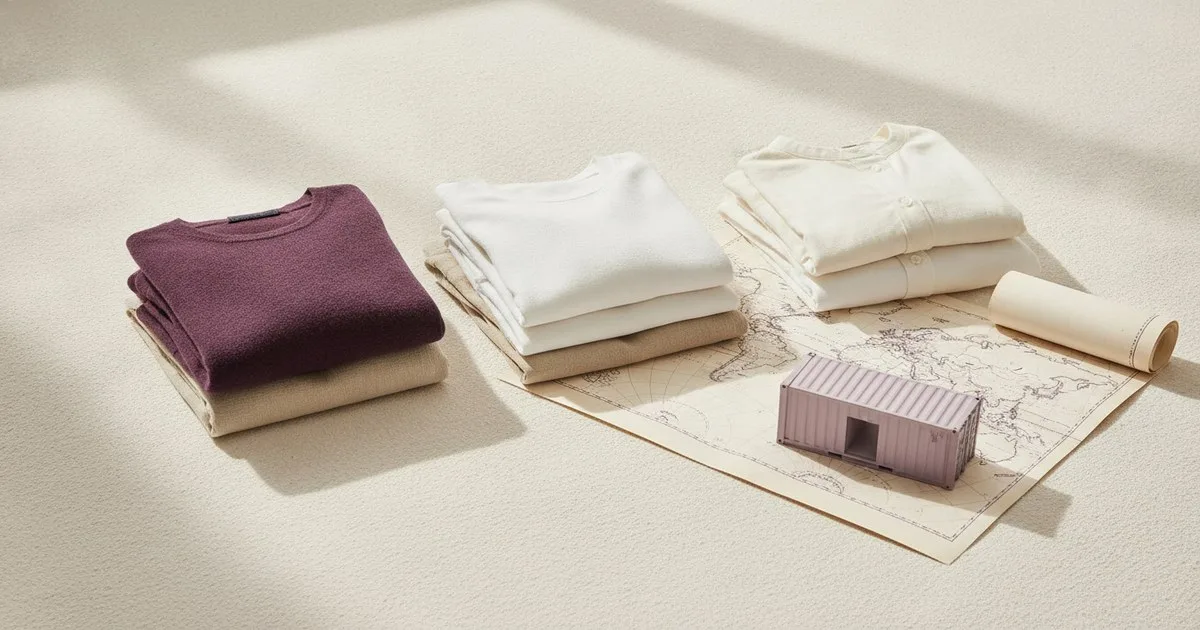
When trade policy shifts, the price tag on your next coat or pair of jeans shifts with it. Import tariffs — taxes charged when goods cross a border — are one of the most direct levers governments pull on global trade, and the apparel industry, which is among the most globally distributed of all manufacturing sectors, feels their effects quickly and deeply. If you have noticed prices creeping upward in your favourite stores, or seen brands quietly shrinking their ranges, tariffs are almost certainly part of the story.
Key takeaways
- Import tariffs are taxes paid by the importing company, not the exporting country — and brands typically pass a significant share of that cost to consumers.
- Apparel supply chains span dozens of countries, so a tariff on one nation's goods can ripple through an entire product line.
- Trade disruptions — from policy changes to natural disasters — compound tariff pressure by forcing brands to reroute sourcing at short notice and at higher cost.
- Sustainability and nearshoring initiatives, while promising, often carry their own cost premiums that also reach the consumer.
- Understanding the mechanism helps you make more deliberate choices about where, when, and how much you spend on clothes.
What is a clothing import tariff, and who actually pays it?
A tariff is a duty levied by a government on goods imported from another country. In the United States, for example, most clothing carries a base tariff rate — historically between 12 and 32 percent depending on the category — before any additional duties are applied. The European Union operates its own schedule, as does the United Kingdom post-Brexit.
Here is the part that often surprises people: the tariff is not paid by the country that made the garment. It is paid by the company importing it — the brand or retailer bringing the goods across the border. That company then decides how much of that cost to absorb in its own margins and how much to pass on to the customer. In practice, brands rarely absorb it all. Research into pricing behaviour across consumer goods consistently finds that a meaningful portion of tariff increases reaches the shelf price, particularly in lower-margin, volume-driven segments of the market.
Luxury and premium brands have more pricing power — their customers are less price-sensitive — but even they face pressure when input costs rise across the board.
How does a garment travel from factory to fitting room?
To understand why tariffs hit so hard, it helps to trace the journey of a single piece of clothing. A cotton shirt sold in London or New York might begin as raw fibre grown in one country, spun into yarn in a second, woven into fabric in a third, cut and sewn in a fourth, and finished with trims sourced from a fifth. Each of those stages may cross a border, and each crossing is a potential tariff point.
This is not inefficiency — it is the result of decades of specialisation, where each country developed expertise in a particular step of the process. Bangladesh became a centre for garment assembly; China for fabric and trims; Turkey for denim; Portugal for knitwear. The system works well when trade rules are stable and predictable. When they are not, the whole chain can seize up.
What is driving trade disruption right now?
Several forces are operating simultaneously, and they are not moving in the same direction.
Geopolitical tariff escalation. Trade tensions between major economies have produced rounds of additional duties on top of baseline rates. Brands that sourced heavily from one country have found themselves facing sharply higher import costs almost overnight, with little time to restructure their supplier base.
Natural disasters and regional shocks. Supply chains are also vulnerable to events that have nothing to do with policy. In August 2026, a high-magnitude earthquake struck Colombia's western region, prompting the country's government to seek tariff relief from the United States for its apparel exporters, who were already navigating existing trade pressures. Colombia is a meaningful supplier of apparel to the US market, and disruptions there illustrate how quickly a localised event can become a global sourcing problem.
Freight and logistics volatility. Even when tariffs are stable, the cost of moving goods is not. Container shipping rates have swung dramatically in recent years, and port congestion can add weeks to delivery timelines — weeks that, in fashion, often mean missing a selling season entirely.
Regulatory and compliance costs. New due-diligence laws in the EU and elsewhere require brands to document their supply chains in greater detail. Compliance is not free, and those costs, too, eventually find their way into pricing.
How do brands respond — and what does that mean for your wardrobe?
Brands have several tools available when tariffs rise, and most use a combination of them.
Price increases. The most direct response. A brand absorbing a 25 percent duty increase on a garment that cost $20 to produce faces a $5 hit per unit before any other costs. Spread across a collection, that is significant.
Supplier diversification. Shifting production to countries with more favourable trade terms — Vietnam, Cambodia, Bangladesh, Morocco, Portugal — is a common response, but it takes time and money. Factories need to be vetted, relationships built, sampling done. A brand cannot simply move a supply chain in a quarter.
Nearshoring. Some brands are bringing production closer to their end markets — manufacturing in Mexico for the US market, or in Eastern Europe for the EU. This reduces tariff exposure and shortens lead times, but labour and overhead costs are typically higher than in traditional low-cost sourcing countries. The consumer often pays the difference.
Product simplification. Quietly reducing the number of styles, colourways, or size ranges in a collection is a way to manage complexity without raising prices visibly. You may not notice that a brand used to offer eight colour options and now offers four.
Material substitution. Swapping a premium fabric for a slightly less expensive one is another lever. This is rarely announced.
What about sustainability — does it make things more expensive?
The short answer is: often, yes, at least in the near term. Sustainable materials — organic cotton, recycled polyester, responsibly sourced wool — typically carry a cost premium over their conventional equivalents. Circular economy approaches, which aim to keep textiles in use for longer and reduce waste, require investment in take-back infrastructure, sorting technology, and new manufacturing processes.
Research into green merchandising in the textile and apparel sector points to the role of supply chain transparency and traceability technology as a key enabler of circular practices — but building that transparency is itself a cost that brands must manage. The good news is that as these practices scale, costs tend to fall. The challenge is that we are still in the early stages of that curve.
Trade policy can complicate sustainability efforts in unexpected ways. If tariffs make it cheaper to source from a country with lower environmental standards than from one with higher standards, the economic incentive pushes in the wrong direction. This is one reason trade policy and sustainability policy are increasingly discussed together in industry forums, including coverage from The Business of Fashion, which tracks how brands are navigating the intersection of cost pressure and environmental commitments.
What is still unresolved?
Several questions do not yet have clean answers.
How much of the cost increase will brands absorb versus pass on? This varies by brand, by category, and by the competitive dynamics of each market segment. There is no universal rule.
Will nearshoring deliver on its promise? Bringing production closer to home markets is appealing in theory, but the skilled workforce, infrastructure, and supplier ecosystems that make low-cost sourcing countries efficient take years to build elsewhere.
How will consumers respond? If prices rise significantly, some consumers will buy less, buy secondhand, or shift to lower-price alternatives. Others will prioritise quality over quantity. The industry is watching closely, and trade publications such as Just Style — part of GlobalData's intelligence portfolio — track these shifts in real time.
What happens when multiple disruptions stack? The Colombia earthquake scenario is a reminder that tariff pressure and natural disaster can arrive simultaneously. Supply chains that are already stretched thin by geopolitical tensions have less slack to absorb additional shocks.
What can you do as a consumer?
You cannot control trade policy, but you can make choices that give you more resilience against price volatility.
- Buy for longevity. A garment that costs more upfront but lasts five years is often cheaper per wear than a cheaper one that lasts one season.
- Watch the secondhand market. Pre-owned clothing is insulated from new-goods tariff pressure. Platforms and charity shops carry items at prices that reflect what someone originally paid, not today's import costs.
- Pay attention to where things are made. Country-of-origin labels tell you something about a garment's supply-chain exposure, even if they do not tell you the whole story.
- Support brands that are transparent about their sourcing. Brands that publish supplier lists and material breakdowns are generally the ones investing in supply-chain resilience — which tends to mean more stable pricing over time.
Trade policy will keep shifting. The brands and consumers who understand the mechanics are better placed to navigate what comes next.
FAQ
What are fashion tariffs and why do they exist? Fashion tariffs are import duties governments charge on clothing brought in from other countries. They exist to protect domestic manufacturers, generate government revenue, or as a lever in trade negotiations. The importing brand pays them, not the exporting country.
Do tariffs always lead to higher clothing prices? Not always, but often. Brands may absorb some of the cost in their margins, especially in competitive market segments. Over time, however, sustained tariff increases tend to push retail prices upward, particularly for volume-priced clothing.
Which countries are most affected by US clothing tariffs? Countries that export large volumes of apparel to the US — including Bangladesh, Vietnam, Cambodia, China, and Colombia — are most directly affected when US tariff policy shifts. A change in duties on goods from any of these countries can affect the price of everyday clothing.
How does a natural disaster affect clothing prices? A disaster that disrupts a major sourcing country forces brands to find alternative suppliers quickly, often at higher cost and with longer lead times. Those extra costs can feed through to retail prices, and the disruption can last well beyond the immediate event.
Is sustainable fashion more expensive because of tariffs? Sustainable fashion carries cost premiums for several reasons — material sourcing, certification, and traceability investment — that are largely separate from tariffs. However, tariff structures that favour lower-cost, less sustainable sourcing can make it harder for sustainable alternatives to compete on price.
What is nearshoring and does it help consumers? Nearshoring means producing clothing in countries geographically close to the end market — Mexico for the US, or Morocco for Europe. It reduces tariff exposure and lead times, but labour costs are generally higher, so the benefit to consumers is more about supply-chain stability than lower prices.
Further reading
- Colombian Leader Implores Trump for Tariff Relief Following Earthquake — WWD / Sourcing Journal
- Green merchandising of textiles and apparel in a circular economy — ScienceDirect