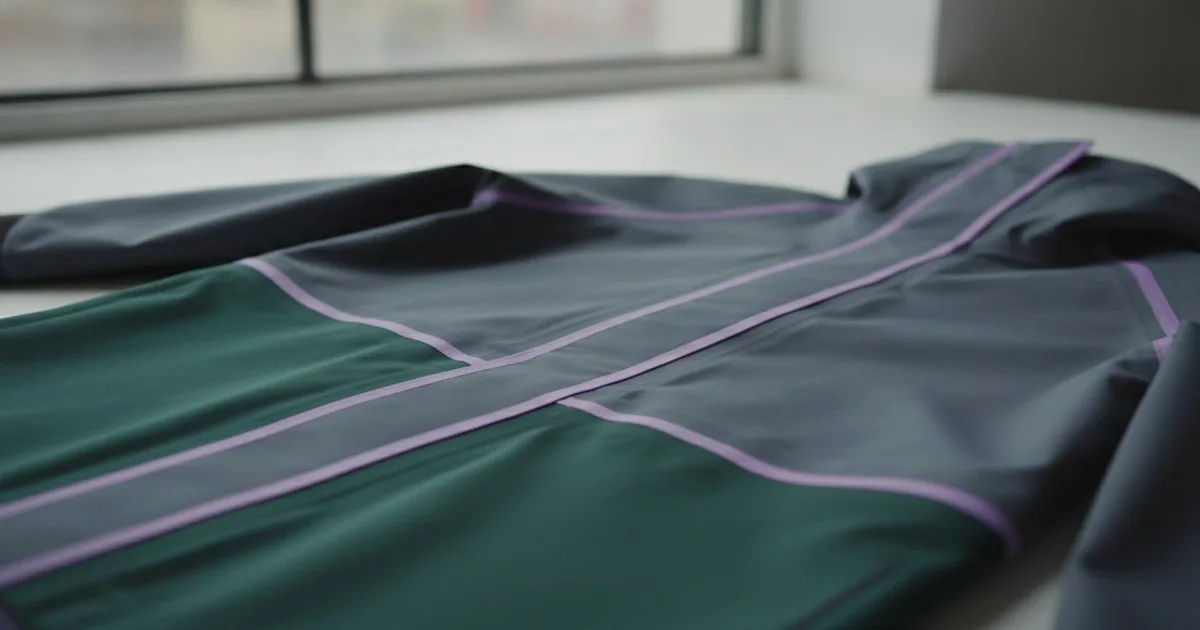
When a jacket costs as much as a plane ticket, you want to understand what you are actually paying for. Arc'teryx — now part of Amer Sports, itself majority-owned by Anta Sports — has spent decades cultivating a reputation for outerwear built to withstand genuine alpine conditions. Public reporting and the brand's own documented practices point to a manufacturing philosophy that is unusually specific about tolerances, materials, and process control. This article draws on what is publicly known to examine how that philosophy works, and what it means for the clothes you eventually wear.
Key takeaways
- Arc'teryx operates its own factory in Vancouver, giving it direct control over construction methods that most brands outsource entirely.
- The brand's seam-sealing and laminate-bonding processes are documented as requiring millimetre-level precision, which shapes both performance and durability.
- Technology investment in manufacturing — from pattern accuracy to quality inspection — tends to extend product lifespan, reducing the cost-per-wear over time.
- Precision manufacturing is not a marketing claim you can verify at the point of sale; understanding the process helps you ask better questions about any technical garment.
- The relationship between manufacturing rigour and sustainability is direct: a garment built to last is, by definition, one that does not need replacing.
What does Arc'teryx actually make, and where?
Arc'teryx designs and sells technical outdoor apparel and equipment: Gore-Tex shell jackets, down parkas, fleece layers, climbing harnesses, trail running apparel, and accessories. The brand operates across several distinct lines — its mainline outdoor collection, Veilance for urban technical wear, LEAF for law enforcement and military use, and PRO for ski patrol professionals. It sells through more than 80 branded stores and roughly 3,000 retail partners worldwide.
What makes the manufacturing story unusual is that Arc'teryx has historically maintained its own production facility in Vancouver, British Columbia — the Bird Academy and the adjacent factory floor. Most apparel brands at this price point design in-house but manufacture entirely through contracted factories in Asia or Eastern Europe. Keeping production close to the design team creates a feedback loop that is difficult to replicate at arm's length: a pattern issue identified on the factory floor can be corrected before it becomes a production run problem.
Why does pattern precision matter so much in technical outerwear?
In a standard woven garment, a seam that is a millimetre off-grain is largely invisible and rarely affects performance. In a laminated Gore-Tex shell, the same deviation can compromise the seam tape that keeps water out. The tape — a thin strip of thermoplastic material bonded over every seam — must align exactly with the stitched seam beneath it. If the seam wanders, the tape either misses its target or creates a fold that eventually peels.
This is why pattern accuracy is not a back-office concern for technical outerwear manufacturers. The pattern — the flat template from which every panel is cut — determines whether the finished garment behaves as designed. A sleeve that is cut fractionally too wide will not sit correctly against a Gore-Tex bib pant, and the gap at the cuff becomes a wind and water entry point. These are not hypothetical failures; they are the kinds of problems that show up on a mountain and cannot be fixed with a needle and thread.
Public reporting on Arc'teryx consistently notes that the brand cuts its laminates with a precision that goes beyond standard apparel tolerances. Laminates — fabrics bonded to a waterproof membrane — cannot be pressed with a conventional iron, cannot be sewn with arbitrary thread tension, and cannot be cut with blunt blades without delaminating at the edge. Each of these constraints pushes the manufacturing process toward tighter control at every step.
How does technology investment translate to quality control?
The connection between technology and quality in garment manufacturing is less obvious than it sounds. Buying expensive machinery does not automatically produce better clothes; what matters is whether the technology is integrated into a process that can detect and correct errors before they leave the factory.
For a brand like Arc'teryx, quality control in manufacturing involves several distinct stages. First, the pattern itself must be accurate — any deviation introduced at the digital pattern stage will be replicated across every cut piece. Second, the cutting must hold that accuracy: automated cutting systems can maintain tolerances that manual cutting cannot, particularly in laminates where blade pressure affects edge integrity. Third, the assembly sequence matters: in a waterproof shell, the order in which panels are joined determines whether seam tape can be applied flat or must bridge a fold. Fourth, the seam sealing itself must be inspected — visually and, in some cases, with air-pressure testing — before the garment is considered finished.
Each of these stages is a potential failure point, and each benefits from process discipline rather than individual skill alone. This is not to diminish the skill of the people involved — seam sealing at this level requires trained hands — but to note that skill applied to a well-designed process produces more consistent results than skill applied to an improvised one.
Tools like Browzwear's 3D digital product creation platform represent one way the broader industry is trying to catch pattern and fit problems before a single physical sample is cut. By simulating how a garment behaves on a virtual body — accounting for fabric weight, stretch, and drape — brands can identify construction issues at the design stage rather than the sampling stage. Whether Arc'teryx uses this specific platform is not publicly confirmed, but the underlying principle — validate digitally, cut physically only when you are confident — is consistent with the precision-first manufacturing philosophy that public reporting attributes to the brand.
What does this mean for the lifespan of the garment?
The practical argument for precision manufacturing is durability. A seam that is correctly taped on day one is a seam that is still waterproof in year five. A laminate that is cut cleanly will not begin delaminating at the edge after a season of compression in a pack. A zipper that is set into a correctly dimensioned opening will not pucker or gap under load.
This is where the sustainability argument becomes concrete rather than aspirational. The McKinsey State of Fashion report, produced annually in partnership with Business of Fashion, has tracked a growing consumer shift toward value and longevity — a recognition that buying less but buying better is both economically and environmentally rational. A technical shell that lasts fifteen years and can be re-waterproofed and repaired is a fundamentally different object from a fashion jacket that needs replacing every two or three seasons.
Arc'teryx supports this argument structurally: the brand offers a repair programme, sells replacement parts (buckles, zippers, cord locks), and has documented processes for re-taping seams on older garments. These are not possible at scale unless the original construction is precise enough that a repair technician can work with the garment's geometry rather than against it.
What are the limits of what public reporting can tell us?
It is worth being honest about what this article cannot confirm. Arc'teryx does not publish detailed manufacturing process documentation for public consumption. The specific machines used, the tolerance specifications applied to each product line, the proportion of garments that fail quality inspection — none of this is in the public record. What public reporting does confirm is the existence of the Vancouver facility, the brand's documented commitment to seam sealing and laminate integrity, and the repair and parts infrastructure that presupposes durable original construction.
There is also a question of consistency across product lines. Arc'teryx's mainline Gore-Tex shells sit at the top of the price range and are the garments most associated with the brand's manufacturing reputation. Whether the same precision standards apply uniformly to every item in the Veilance line, the trail running category, or the entry-level Norvan pieces is not something public reporting resolves with confidence. Price is a rough proxy — lower-priced items in any brand's range typically involve more cost-managed production — but it is not a precise one.
How should you use this information as a consumer?
Understanding the manufacturing process behind a technical garment changes how you evaluate it at the point of sale. Rather than accepting 'waterproof' as a binary claim, you can ask: how are the seams sealed, and across how much of the garment? Rather than accepting 'durable' as a marketing word, you can ask: does the brand offer repair, and can I source replacement parts? Rather than treating the price as a number to negotiate down, you can ask: what is the cost per year of ownership if this garment lasts a decade?
These are not questions that require technical expertise to ask. They are questions that precision manufacturing either answers or does not, and a brand with genuine process rigour will have clear, specific answers ready.
The broader point is that manufacturing technology — pattern accuracy, cutting precision, seam integrity, quality inspection — is invisible in the finished garment but present in everything the garment does over its life. Buying a technically demanding jacket is, in part, a bet on the process that produced it. Public reporting on Arc'teryx suggests that bet has a reasonable basis. What it cannot tell you is exactly how that process is implemented today, or how it compares in detail to competitors you cannot see inside either.
That uncertainty is not a reason to distrust the brand. It is a reason to stay curious, to use the repair programme when a zip fails rather than replacing the jacket, and to treat longevity — not novelty — as the measure of value.
FAQ
Does Arc'teryx make its own clothes, or does it outsource production? Arc'teryx has operated its own factory in Vancouver, British Columbia, which is publicly documented. The brand also works with external manufacturing partners for parts of its range. The Vancouver facility is particularly associated with its most technically demanding shell garments.
What makes Arc'teryx seam sealing different from other waterproof jackets? Public reporting describes Arc'teryx as applying seam tape across every seam in its fully-taped shells, rather than only the critical seams. The tape must align precisely with the underlying stitch line, which requires accurate pattern cutting and trained application — both of which are documented aspects of the brand's process.
Is Arc'teryx owned by a Chinese company? Arc'teryx is part of Amer Sports, which is majority-owned by Anta Sports, a Chinese sportswear company. Amer Sports also owns Salomon, Wilson, and several other outdoor and sports brands. Arc'teryx continues to operate with its own design and, in part, its own manufacturing infrastructure.
Can Arc'teryx jackets be repaired if they wear out? Yes. Arc'teryx operates a repair programme and sells individual replacement components including zippers, buckles, and cord locks. The brand's repair infrastructure is one of the publicly documented ways its manufacturing precision translates into long-term consumer value.
How does precision manufacturing relate to sustainability? A garment built to precise tolerances is more likely to perform as intended over many years, reducing the need for replacement. Durability is one of the most direct paths to a lower environmental footprint in apparel, because the production of a new garment carries a far larger impact than the repair or continued use of an existing one.
What is the difference between Arc'teryx's main line and Veilance? Arc'teryx mainline focuses on technical outdoor performance — mountaineering, skiing, trail running. Veilance applies similar construction standards to urban and travel wear, with cleaner aesthetics and less technical hardware. Both lines use premium materials and the brand's seam-sealing methods, though the specific performance targets differ.