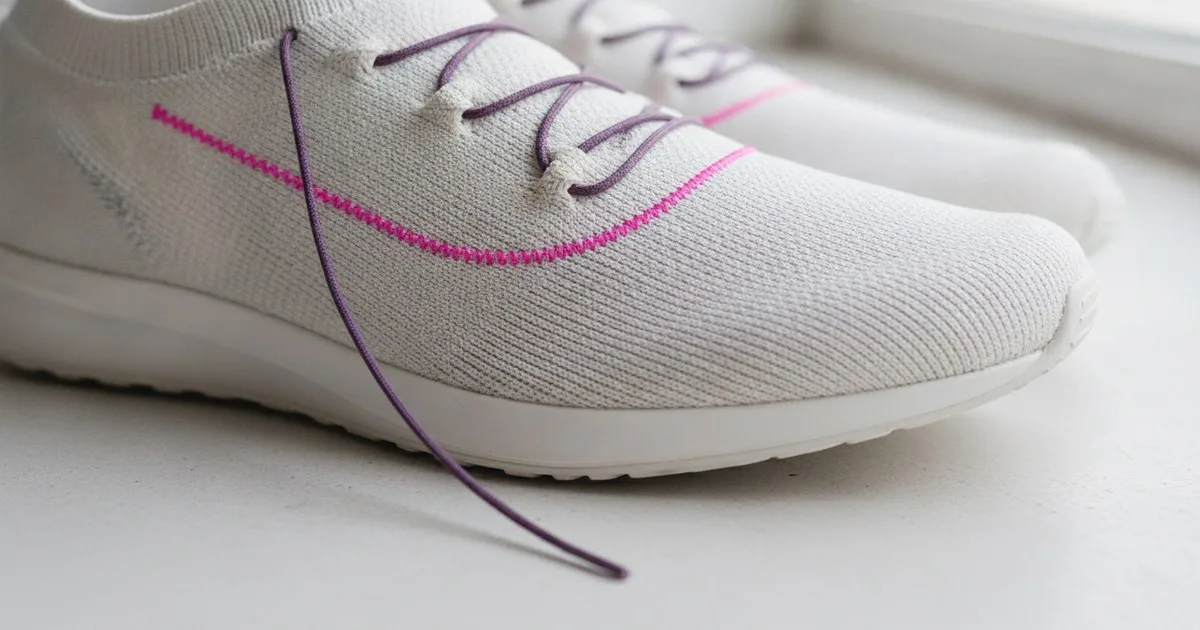
When you lace up a pair of running shoes, the story behind them is usually invisible — hundreds of decisions about materials, fit, and construction compressed into something that weighs less than 300 grams. On has made a point of pulling some of that story into the open, through press releases, annual filings, and event announcements that together sketch a picture of how the Swiss brand thinks about building products. What follows draws entirely on that public record.
Key takeaways
- On has developed a robotic upper-production technology called LightSpray™ that collapses what is traditionally a multi-step manufacturing process into a single automated sequence.
- The brand has moved from a single pilot facility to a global manufacturing footprint for this technology in under two years.
- Digital product creation — designing and validating a product on screen before committing to physical samples — is the upstream discipline that makes this kind of precision manufacturing possible.
- Tools like Browzwear's physics-based 3D simulation platform are representative of the category On and its peers draw on to reduce physical sampling and accelerate development.
- The gap between a brand's public ambition and the full technical detail of its workflow is real; consumers can read the headlines, but the engineering sits largely behind closed doors.
What does "digital product creation" actually mean in footwear?
The phrase gets used loosely, so it is worth being precise. Digital product creation (DPC) in footwear and apparel refers to the practice of designing, fitting, and approving a product — or as much of it as possible — using software rather than physical prototypes. Instead of cutting a sample from fabric, sewing it, shipping it to a fit model, marking it up, and starting again, a design team works in 3D simulation environments where a virtual upper can be tested for fit, flex, and appearance before a single piece of material is cut.
The benefits are not abstract. Physical sampling is expensive, slow, and generates waste at every iteration. A brand running ten rounds of physical prototypes on a single style is spending money and time that digital tools can compress. The environmental argument follows the same logic: fewer physical samples means less material consumed and fewer air-freight shipments between design studios and factories.
This is the context in which On's public announcements make most sense.
What has On said publicly about its manufacturing process?
The clearest window into On's product-creation thinking comes from its LightSpray™ technology, which the brand has described in detail across several press releases.
LightSpray™ is a method for producing shoe uppers — the part that wraps your foot — using a robotic arm and a continuous filament. Traditional upper production involves around 200 steps spread across multiple locations, from yarn manufacture through to final assembly. On's facility in Zurich, which opened in mid-2025, demonstrated that a robot arm and roughly 1.5 kilometres of filament can produce a one-piece upper in approximately three minutes. The process is fully automated and runs in a single step.
The significance of that compression — from 200 steps to one — is hard to overstate from an engineering perspective. Each step in a traditional process is a point where variation can enter: a seam placed slightly off, a material bonded at the wrong temperature, a component sourced from a different supplier batch. Collapsing the process reduces those variables. It also changes what "design" means, because the geometry of the upper is now encoded in the robot's path rather than in a pattern cut from sheet material.
How quickly is On scaling this technology?
The Zurich facility opened with four robots. By early 2026, On had opened a second facility near Busan, South Korea, adding 32 robots and increasing global LightSpray™ production capacity roughly 30-fold for the year. Further growth was described as planned beyond that.
This is an unusually fast scaling arc for a manufacturing technology in footwear. Most production innovations take years to move from pilot to meaningful commercial volume. The speed suggests that the digital infrastructure upstream — the design files, the simulation models, the process parameters — was mature enough to replicate across a new facility without the usual delays of re-engineering for a new context.
Where does 3D design software fit in?
Robotic manufacturing of the kind On has built depends on precision upstream. A robot arm following a filament path has no tolerance for ambiguity in the design specification; every curve, every density, every transition point has to be defined digitally before production begins. That makes the quality of the digital design file the foundation of everything that follows.
This is where the broader category of 3D fashion design software becomes relevant. Platforms like Browzwear — whose tools include physics-based garment and material simulation, AI-assisted fit validation, and connected workflows that carry a design from first sketch through to factory-ready technical documentation — represent the kind of infrastructure that performance brands build their development pipelines around. Browzwear's platform lets a design team simulate how a material will behave under stress, validate fit across size ranges, and generate the technical assets a factory needs, all before a physical sample is made.
On has not publicly named every tool in its design stack, and it would be wrong to assume any specific software relationship that has not been confirmed. What is clear from the public record is that the precision required by LightSpray™ production is only achievable if the design data feeding it is equally precise — and that precision is what digital product creation tools are built to provide.
What does On's financial picture say about where the brand is heading?
Product innovation does not happen in isolation from commercial performance. On's full-year results for 2025 showed net sales reaching CHF 3,014.0 million, a 30.0% increase year-over-year, with the brand describing itself as entering the final year of a three-year strategy from a position of significant strength. The annual report specifically named further scaling of LightSpray™ technology as one of the pillars of the next phase of growth, alongside expanding the apparel offering and deepening premium brand expression.
For a consumer reading that, the practical implication is this: the robotic manufacturing technology is not a marketing story or a limited-edition experiment. It is described in On's own filings as central to the brand's commercial strategy going forward.
What is still unsolved — or at least undisclosed?
The public record has real limits, and it is worth naming them.
The upstream design workflow. On has described what LightSpray™ produces and how the robot operates, but the design process that generates the filament path — the software, the simulation steps, the iteration cycles — is not described in public filings. Brands at this level of technical sophistication typically use a combination of proprietary tools and commercial platforms, but the specific combination is not something On has disclosed.
Fit and sizing data. One of the hardest problems in footwear is ensuring that a digitally designed upper fits real feet across a full size range. The industry uses a combination of 3D foot-scan databases, physics simulation, and physical wear testing to close this gap. On has not published detail on how it handles this for LightSpray™ products specifically.
Material sourcing and sustainability accounting. LightSpray™ reduces process steps, which reduces energy and waste at the manufacturing stage. But the environmental story of a shoe includes the upstream production of the filament itself, the energy profile of the robotic facility, and the end-of-life behaviour of a one-piece upper that cannot be disassembled in the way a traditionally constructed shoe can. These questions are live in the industry and not yet answered in On's public materials.
Apparel. On has flagged apparel expansion as a strategic priority, and digital product creation for garments — where fit variation is even more complex than in footwear — is a different discipline. How On approaches garment development digitally is not covered in the sources available.
Why does this matter to you as a consumer?
The honest answer is that most of this engineering is invisible at the point of purchase. You are not buying a manufacturing process; you are buying a shoe. But understanding the process changes what you notice. A one-piece upper with no seams is not a design choice in the aesthetic sense — it is a consequence of how the shoe was made. The weight, the breathability, the way the upper responds to your foot's movement: all of these are downstream effects of decisions made in a digital design environment long before the robot arm began its three-minute run.
There is also a longer-term consumer interest in whether brands that invest heavily in digital and robotic manufacturing pass any of the efficiency gains back through price, availability, or customisation. Robotic production that can be reprogrammed for different designs opens the theoretical possibility of smaller production runs, regional manufacturing, and eventually made-to-order products. On has not made that promise publicly, but the infrastructure they are building is the kind that could support it.
Industry events like PI Apparel — where brands and technology vendors meet to work through exactly these questions — give some sense of how the conversation is developing across the sector. The direction of travel is consistent: more digital, earlier in the process, with physical samples reserved for final validation rather than iterative exploration.
FAQ
What is LightSpray™ and how is it different from traditional shoe manufacturing? LightSpray™ is On's robotic upper-production process. A robot arm uses a continuous filament to produce a one-piece upper in a single automated step, replacing a process that traditionally involves around 200 steps across multiple locations. The result is a seamless upper produced with significantly less process complexity.
Does On use 3D design software to create its shoes? On has not published a detailed account of its design software stack. What is clear is that robotic precision manufacturing of the kind LightSpray™ represents requires highly precise digital design files upstream. The broader industry uses platforms like Browzwear for physics-based 3D simulation, fit validation, and technical documentation, though On has not publicly confirmed its specific tools.
Is On's LightSpray™ technology more sustainable than conventional manufacturing? Reducing the number of manufacturing steps reduces energy use and material waste at the production stage. The full environmental picture — including the upstream production of the filament and the end-of-life behaviour of a one-piece upper — is not yet fully addressed in On's public materials. It is a live question in the industry.
How fast is On scaling its robotic manufacturing? On opened its first LightSpray™ facility with four robots, then opened a second facility adding 32 more robots, targeting a roughly 30-fold increase in production capacity. That is a fast scaling arc for a new manufacturing technology in footwear.
Could robotic manufacturing eventually mean made-to-order shoes from On? On has not made that commitment publicly. But robotic production that can be reprogrammed for different designs is the kind of infrastructure that could, in principle, support smaller runs and more personalised products. It is a reasonable question to watch over the next few years.
What is digital product creation and why do running brands care about it? Digital product creation means designing and validating a product in software — using 3D simulation, fit modelling, and digital technical documentation — before committing to physical samples. For performance brands, it reduces the cost and waste of iterative prototyping and produces more precise design data for advanced manufacturing processes.
Further reading
- On opens the world's first LightSpray™ production facility in Zurich — On newsroom
- On scales LightSpray™ with new South Korea factory — On newsroom
- On announces full-year results and annual report filing for 2025 — On newsroom