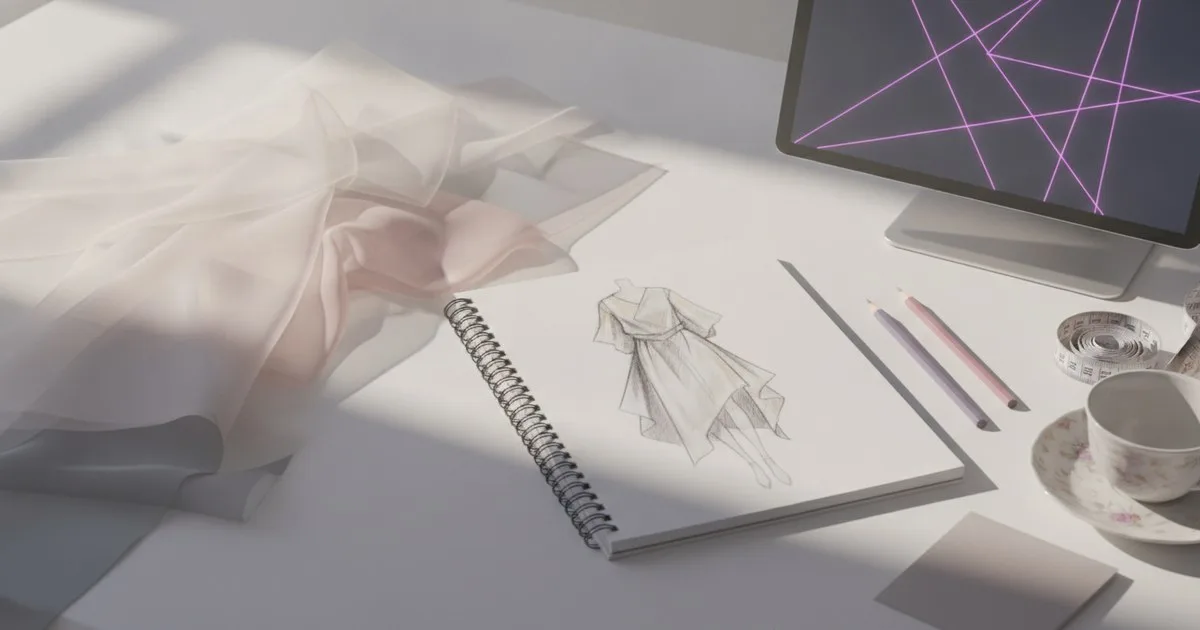
For most of fashion's history, the gap between a designer's idea and a finished sample ran to weeks — sometimes months. Today, a growing number of brands are using generative AI to collapse parts of that timeline into hours. The change is real, but it raises questions worth sitting with: what actually gets faster, what stays stubbornly slow, and does compressing the calendar always serve the clothes — or the people who wear them?
Key takeaways
- Generative AI tools can accelerate early-stage design and visualisation tasks that once took days, freeing designers to spend more time on creative decisions.
- Speed gains are concentrated in concept generation, colorway exploration, and digital asset creation — physical sampling and supply-chain lead times remain largely unchanged.
- Faster product development can reduce waste when it replaces physical sampling with digital review, but it can also encourage higher volumes if brands treat the saved time as capacity for more styles.
- Brands using AI for product creation are increasingly building connected workflows that link design, merchandising, and supplier data in a single environment.
- The sustainability case for AI in product development depends almost entirely on what brands choose to do with the time they save.
What does AI actually do in fashion product development?
The phrase "AI in fashion" covers a wide range of tools doing very different things. At the product development stage, the most relevant applications fall into a few clear categories.
Concept and sketch generation. Designers describe a garment — silhouette, fabric hand, mood, reference era — and a generative model produces visual options in seconds. This is useful not because the AI makes creative decisions, but because it externalises possibilities quickly enough that a design team can react to them, discard most, and develop the few that resonate. Raspberry AI offers this kind of end-to-end creative environment, moving from sketch-to-render through to lifestyle photography and video, so that design, product, and marketing teams can work from a shared visual language rather than passing files between disconnected tools.
Colorway and print exploration. Applying a new colorway to a developed silhouette used to require a new physical sample or a careful session in CAD software. AI-assisted tools can generate dozens of colorway or print variations on a base design in minutes, letting merchants and designers align on direction before any physical material is cut.
Digital product assets. Tech packs, flat sketches, and product photography are all time-consuming to produce. Several platforms now generate or accelerate these assets from the same design file, reducing the handoff friction between design and production teams.
Trend and assortment intelligence. Some platforms layer market signals and consumer data into the product creation process, helping teams build assortments that reflect what is actually selling rather than what seemed appealing six months ago at a trade show.
How are brands using these tools in practice?
Hugo Boss — which designs and retails premium menswear and womenswear under its BOSS and HUGO labels globally — has been among the more visible adopters of digital product creation methods, integrating 3D design and digital sampling into its development process to reduce the number of physical prototypes required before a style reaches production.
The logic is straightforward: every physical sample that can be replaced by a digital review saves material, shipping, and time. When a design team can share a photorealistic 3D render with a buyer or a merchandising director and get sign-off digitally, the sample round that would have followed — and the two to four weeks it typically takes — can be skipped entirely.
Vibe IQ approaches the problem from the assortment side, using AI agents to connect financial plans and market signals with the product creation process. Rather than treating design and merchandising as sequential handoffs, it aims to run them in parallel — so that a concept is being evaluated against range architecture and open-to-buy at the same time it is being visualised.
Refabric similarly offers AI-assisted design generation tools aimed at helping brands move from trend input to product concepts more fluidly, reducing the manual work of translating a mood board into a workable design direction.
What still takes as long as it always did?
It is worth being honest about the limits. AI compresses the parts of product development that involve generating, reviewing, and iterating on visual and data assets. It does not touch the parts that involve physical reality.
Fabric sourcing lead times — the weeks or months between a brand placing a fabric order and the mill delivering it — are unchanged. Factory capacity and cut-make-trim scheduling are unchanged. Fit sessions, which require a physical garment on a physical body (or a very precise digital avatar), are still a bottleneck for anything where fit is critical. Regulatory compliance, labelling, and — increasingly — digital product passport requirements add their own timelines regardless of how quickly the design was conceived.
The Business of Fashion has reported on the incoming mandatory digital product passport requirements in the EU, which will require brands to attach verifiable data about materials, origin, and recyclability to every product. That is a documentation and supply-chain challenge that no design AI solves on its own — though platforms that build structured product data from the design stage outward are better positioned to feed those passports than teams still working in disconnected spreadsheets.
Is faster development better for sustainability?
This is the question that deserves the most careful answer, because the honest answer is: it depends entirely on what a brand does with the speed.
The clearest sustainability benefit of AI-assisted development is the reduction in physical sampling. A sample garment requires fabric, trims, labour, and shipping — often across multiple continents — before it is reviewed and frequently discarded or archived. If digital review genuinely replaces sample rounds rather than simply adding a digital step before the same number of physical samples, the material savings are real.
The harder question is whether brands use the time and cost savings from faster development to produce more styles, more often. If AI allows a team that previously developed 200 styles a season to develop 400, the per-style efficiency gain is absorbed by volume growth — and the net environmental impact may be worse, not better. The tool is neutral; the strategy is not.
Made-to-order and near-demand production models are where the combination of speed and sustainability becomes genuinely compelling. A brand that can move from a confirmed consumer signal to a production-ready design in days, rather than weeks, is better placed to produce only what has already been requested. AI-assisted product development is a meaningful enabler of that model — but only for brands that have built the supply-chain infrastructure to match.
What does a faster development workflow actually look like?
For a brand beginning to integrate AI into its product development process, the change tends to happen in stages rather than all at once.
- Concept generation. Designers use generative tools to produce visual options from briefs, trend inputs, or reference images. This replaces or supplements the mood-board-to-sketch phase.
- Digital review and sign-off. Photorealistic renders or 3D simulations replace early physical samples for internal alignment between design, merchandising, and commercial teams.
- Asset production. Tech packs, flat sketches, and marketing imagery are generated or accelerated from the approved design, reducing the time between sign-off and supplier briefing.
- Assortment integration. Product data flows into range-planning and PLM environments, so that the approved design is immediately visible to the teams managing open-to-buy, supplier allocation, and production scheduling.
- Iteration on feedback. When a buyer or a market team requests a change — a different length, a revised colorway — the design team can respond digitally in hours rather than commissioning a new sample.
The brands seeing the most meaningful time savings are those that have connected these steps into a single workflow rather than treating each tool as a standalone addition to an otherwise unchanged process.
What should you watch for as a consumer?
None of this is invisible to the people who buy the clothes. A few things are worth paying attention to.
More options, faster. AI-assisted development allows brands to test more concepts with less upfront investment, which means more styles reaching market — some of which will be genuinely interesting, and some of which will be volume for its own sake.
Digital product passports. As EU requirements come into force, you will increasingly be able to scan a garment and see verified information about where its fabric was made, what it contains, and how to recycle it. Brands that have built structured digital product data from the design stage will find this easier to deliver accurately.
Made-to-order signals. Watch for brands explicitly using faster development cycles to offer near-demand or made-to-order production. That is the version of this story where speed and sustainability genuinely align.
Quality signals. Faster concept generation does not guarantee better clothes. The brands using AI well are using it to free their designers for the decisions that require human judgment — proportion, construction, material choice — rather than replacing those decisions with algorithmic output.
FAQ
How much faster does AI make fashion product development? The speed gains are most pronounced in early-stage tasks: concept visualisation, colorway exploration, and digital asset creation can move from days to hours. Physical sampling, fabric sourcing, and factory scheduling are not meaningfully affected by current AI tools.
Does AI replace fashion designers? Not in the roles that require creative judgment, technical construction knowledge, or understanding of how a garment will feel and move on a body. AI handles the generative and iterative tasks that previously consumed time designers would rather spend on decisions only they can make.
Can faster AI development reduce fashion's environmental impact? It can, if brands use digital review to replace physical samples and use the speed to produce closer to demand. If they use it to produce more styles at the same or higher volume, the net impact is likely negative. The tool is neutral; the strategy determines the outcome.
What is a digital product passport, and does AI help with it? A digital product passport is a structured record of a garment's materials, origin, and end-of-life options, attached to the product via a scannable code. EU regulations are making these mandatory for textile products. AI tools that build structured product data from the design stage outward make it easier to populate these passports accurately — but the underlying supply-chain data still has to exist.
Which types of brands benefit most from AI product development tools? Brands with high style counts, frequent drops, or made-to-order ambitions tend to see the clearest benefits, because the speed gains compound across many styles. Smaller studios benefit from reduced asset-production overhead. The tools are less transformative for brands whose bottleneck is physical — fabric lead times, factory capacity, or fit complexity.
Is AI-generated fashion design creative? Generative AI produces options; designers make choices. The creative act is in the curation, the direction-setting, and the judgment about what serves the brand and the wearer. Designers who use AI well describe it as having a very fast, very literal assistant — useful precisely because it externalises possibilities quickly enough to react to.
Further reading
- How Fashion Brands Should Prepare for Mandatory Digital Product Passports — Business of Fashion