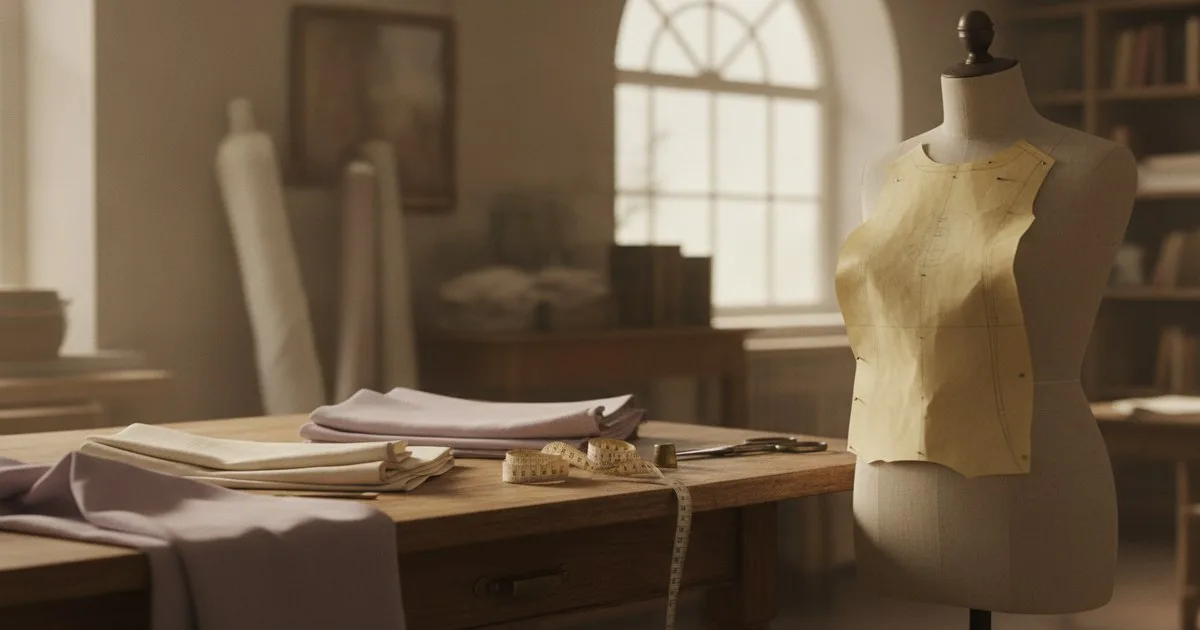
Made-to-order clothing is exactly what it sounds like: a garment that does not exist until you ask for it. No warehouse shelf, no size run sitting in a distribution centre, no guesswork about whether the medium will sell. The brand makes your piece after you place the order. That single shift in sequence changes almost everything — the price, the timeline, the environmental footprint, and the way the clothes fit.
Key takeaways
- Made-to-order garments typically cost more upfront than their mass-market equivalents, but that premium reflects real labour and the absence of speculative overproduction.
- Lead times range from a few days for digitally automated pieces to six or eight weeks for fully hand-crafted garments — knowing which you are buying matters.
- The model eliminates the unsold-stock problem that plagues conventional retail: a garment that was never made cannot end up destroyed.
- Fit is the strongest argument for made-to-order, but the quality of the fit depends entirely on how well the brand captures your measurements.
- Made-to-order is not one thing: it spans everything from a $30 print-on-demand T-shirt to a $4,000 tailored coat, and the experience differs just as much as the price.
What does "made-to-order" actually mean?
The term covers a wide spectrum, and conflating its ends leads to disappointment. At one end sits print-on-demand: a design is printed onto a blank garment only when someone orders it. The blank itself is mass-produced; the customisation is surface-level. At the other end is bespoke tailoring, where a pattern is drafted from your measurements alone, toiles are made and fitted, and the finished garment is constructed by hand over several weeks.
Between those poles you find made-to-measure, where a base pattern is adjusted to your measurements rather than drafted from scratch, and on-demand manufacturing, where a brand produces standard-sized garments in small batches triggered by actual orders rather than forecasts. Each model has a different price structure and a different relationship to fit.
When this article talks about made-to-order in the consumer sense — the version most likely to cross your path — it means the middle ground: garments cut and sewn after your order is placed, often with some degree of size or style personalisation.
Why does it cost more?
Conventional fashion is cheap in part because it is produced speculatively and at enormous scale. A factory running thousands of identical units per day spreads its fixed costs very thin. Made-to-order breaks that logic. Each order triggers its own production run, which means setup time, individual cutting, and often more skilled labour per unit. You are also, in a sense, paying for what is not made: no excess stock, no markdown cycle, no clearance sale to recoup losses.
There is a research basis for the willingness to pay that premium. A study published in Heliyon found that consumers who co-create or customise a product develop a stronger attachment to it and report higher satisfaction — a dynamic that makes the higher price feel more justified after the fact.
That said, the premium is not uniform. A made-to-order linen dress from a small studio might cost £180 where a fast-fashion equivalent costs £35. A made-to-measure suit from a heritage tailor might cost £1,200 where an off-the-rack version costs £300. The gap is real, but it is not arbitrary: it maps fairly closely onto the labour and material inputs that mass production compresses out.
What are the realistic lead times?
This is where made-to-order most often surprises first-time buyers — and not always pleasantly.
Digitally automated pieces (print-on-demand, some knitwear, cut-and-sew with digital pattern files) can ship within three to seven days. The production step is fast; the bottleneck is shipping.
Small-studio made-to-order — a dressmaker or a small brand cutting and sewing individual orders — typically runs two to four weeks. That window covers pattern adjustment, fabric sourcing if the cloth is not held in stock, cutting, construction, and finishing.
Made-to-measure tailoring runs four to eight weeks for a first garment, sometimes longer for a house you have not worked with before. A second order from the same maker is usually faster because your pattern already exists.
The practical implication: made-to-order is not for the week before a wedding you forgot about. It rewards planning. If you treat it as a considered purchase rather than an impulse, the wait becomes part of the experience rather than a frustration.
The environmental case — and its limits
One of the most cited arguments for made-to-order is that it eliminates unsold stock. This matters more than it might seem. A European Environment Agency briefing published in March 2024 estimated that between 264,000 and 594,000 tonnes of textiles are destroyed each year in Europe before they are ever worn, and that an average of around 21% of textile products put on the market go unsold. A garment made only when someone orders it cannot become part of that figure.
The caveat is that made-to-order does not automatically mean low-impact in every other dimension. Fabric choice, dye processes, shipping distance, and packaging all still apply. A made-to-order piece in virgin polyester, air-freighted from the other side of the world, may have a higher carbon footprint than a well-made secondhand coat. The model removes one source of waste; it does not remove all of them.
How does fit actually work?
Fit is the most compelling reason to try made-to-order, and also the most variable.
The simplest version asks for standard measurements — bust, waist, hips, height — and uses them to select or grade a pattern. This works well for simple silhouettes and forgiving fabrics. It works less well for structured tailoring, where the distance between your shoulder blades, the slope of your shoulders, and the length of your torso all matter independently.
More sophisticated approaches use body-scanning technology or proprietary measurement software. Unspun, for example, built a custom-fit patterning engine that generates jeans to each customer's unique body shape, assembled via cut-and-sew after the pattern is generated from the customer's measurements. The result is a zero-inventory model where no two pairs of jeans are identical.
For most small-studio made-to-order, the honest answer is: the fit will be better than a standard size if the maker is skilled and your measurements are accurate. It will not be as precise as a bespoke garment that has been fitted on your body in person. Managing that expectation before you order saves disappointment.
Who is making made-to-order possible at scale?
The infrastructure behind made-to-order has changed considerably. Brands that want to offer personalised or on-demand production now have access to platforms and tools that were not available a decade ago.
Cala — operating its Mercer platform — connects designers and brands to a global manufacturing network, with AI-assisted design tools, tech pack collaboration, and production logistics built into one place. For a small brand that wants to offer made-to-order without managing its own factory relationships, a platform like this compresses the operational complexity considerably.
On the pattern and design side, tools that allow designers to generate and adjust patterns digitally — rather than drafting every variation by hand — make small-run and on-demand production more economically viable. Tailornova offers 3D fashion design software that lets independent designers and small studios create and preview garments before cutting a single piece of fabric, which reduces sampling costs and helps catch fit issues earlier in the process.
These tools do not replace skilled makers, but they reduce the overhead that has historically made small-run production prohibitively expensive.
Is it for you? A practical guide
Made-to-order suits some wardrobes and some shopping habits better than others. Here is a straightforward way to think about it.
It is likely a good fit if:
- You find standard sizing consistently frustrating — too long in the body, too narrow in the shoulders, too wide in the hip for your frame.
- You are building a wardrobe slowly and deliberately rather than buying frequently.
- You care about where and how your clothes are made and want a direct relationship with the maker.
- You are buying something that needs to last: a coat, a suit, a dress for a significant occasion.
It is probably not the right model if:
- You need something quickly.
- You are not sure what you want and rely on trying things on to decide.
- You are working with a tight budget and the premium is genuinely prohibitive.
- You buy clothes frequently and in volume — made-to-order at that pace becomes logistically complicated and expensive.
None of these are absolute rules. Some people find that switching even one or two annual purchases to made-to-order changes how they think about the rest of their wardrobe — fewer pieces, better chosen, worn more often.
What can go wrong?
Made-to-order is not without its failure modes, and it is worth knowing them before you commit.
Measurement errors are the most common. If you measure yourself and get it wrong — or if the brand's measurement guide is ambiguous — the garment may not fit despite being "custom." Some brands offer a remake or alteration allowance; many do not.
Fabric substitution happens when a brand runs out of the fabric shown in the product image and substitutes something similar. In a made-to-order model, this can happen after you have already paid and are waiting.
Lead time creep is real in small studios, especially during busy seasons. A four-week estimate can become six if the maker is overwhelmed. Ask about current turnaround before ordering.
Returns are often not accepted, or accepted only for store credit. Because the garment was made for you, reselling it is harder for the brand. Read the returns policy carefully.
FAQ
What is the difference between made-to-order and bespoke? Made-to-order means a garment is produced after you place your order, usually from a standard or lightly adjusted pattern. Bespoke means a pattern is drafted from your measurements alone, with fittings along the way. Bespoke is slower, more expensive, and more precise.
How do I take my measurements accurately for an online made-to-order brand? Use a soft tape measure and measure over fitted underlayers, not bulky clothing. Follow the brand's specific guide rather than a generic one — brands draft to different ease allowances. If possible, have someone else take the measurements rather than doing it yourself.
Is made-to-order clothing actually more sustainable? It eliminates the unsold-stock problem, which is a meaningful source of textile waste. But sustainability also depends on fabric choice, production location, and shipping method. Made-to-order is one part of a more considered approach, not a complete answer on its own.
Can I return a made-to-order garment if it does not fit? Policies vary widely. Many brands do not accept returns on made-to-order pieces because the garment cannot easily be resold. Some offer alterations, remakes, or store credit. Always read the returns policy before purchasing.
How long should I expect to wait? Anywhere from a few days for digitally automated pieces to six or eight weeks for hand-crafted tailoring. Most small-studio made-to-order falls in the two-to-four-week range. Ask the brand for their current lead time, not just the estimate on the product page.
Further Reading
- Custom-Fit Jeans and OneWeave™ 3D Weaving Technology — unspun
- The destruction of returned and unsold textiles in Europe — European Environment Agency