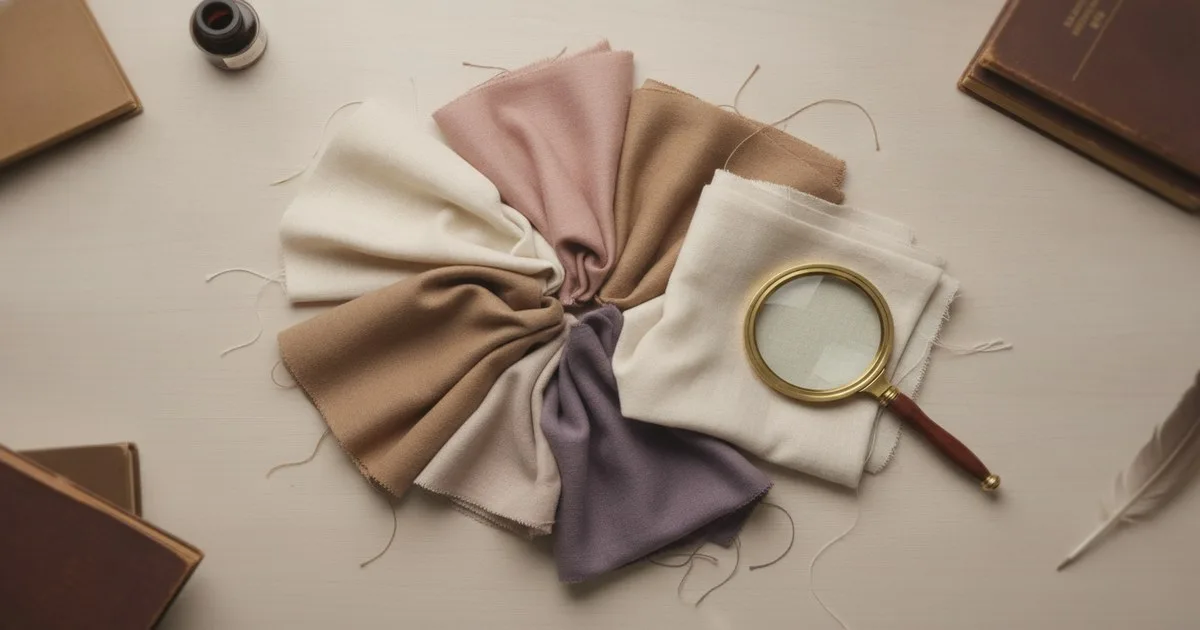
You cannot run a fabric between your fingers on a product page, but the information you need is almost always there — buried in a fibre-content label, a weight figure, a weave description, or the way a model photograph drapes. Once you know what to look for, reading a listing becomes a surprisingly reliable substitute for touch.
Key takeaways
- Fibre content is the single most predictive detail on any product listing; natural fibres and quality blends behave in consistent, well-documented ways.
- Fabric weight (gsm) tells you whether a piece will feel substantial or sheer before it arrives.
- How a garment moves in photography — whether it pools, clings, or holds a crease — reveals more than any marketing adjective.
- Weave and knit structure descriptions (twill, jersey, dobby, ponte) carry specific meaning; learning a handful of terms pays dividends across every future purchase.
- Digital fabric platforms are beginning to make laboratory-grade material data available to curious shoppers, closing the gap between screen and hand.
What you need before you start
- The product listing open in a browser, ideally on a screen large enough to zoom into photography
- A notes app or a simple spreadsheet to compare two or more items side by side
- Five to ten minutes per item — this is slower than impulse-buying, and that is the point
- A basic vocabulary of fibre names and weave terms (this guide provides it)
Step 1: Find and decode the fibre content
Scroll past the headline and the lifestyle copy until you reach the product details panel — usually labelled 'Materials', 'Composition', or 'Care'. The fibre content is listed as percentages: for example, '78% viscose, 20% polyamide, 2% elastane'.
Read it in this order. First, identify the dominant fibre — the one with the highest percentage. That fibre sets the character of the fabric. Then note any secondary fibres, which modify the hand, the stretch, or the durability.
Natural fibres and what they signal
- Cotton — breathable, absorbent, prone to creasing; heavier weights (180 gsm and above) tend to hold their shape better than lighter ones.
- Linen — naturally textured, cool to wear, creases readily; a slight irregularity in the weave is a mark of authenticity, not a flaw.
- Wool — insulating and resilient; look for a breed or grade specification ('merino', 'lambswool') as a sign that the brand knows its supply chain.
- Silk — lustrous and temperature-regulating; a very low price is a reliable warning sign that the fibre content may be misleading.
- Cashmere — warmth-to-weight ratio is exceptional; 100% cashmere at an implausibly low price almost always means short fibres that pill quickly.
Synthetic and semi-synthetic fibres
- Polyester — durable and crease-resistant; in a high-quality weave it can be excellent, but in a low-quality one it traps heat and pills.
- Viscose / Rayon — made from wood pulp; drapes beautifully but can shrink or distort when wet unless treated.
- Lyocell (Tencel) — a more stable form of cellulosic fibre; stronger when wet than viscose and often a sign of a more considered supply chain.
- Elastane / Spandex / Lycra — added in small amounts (2–5%) for stretch recovery; above 10% the fabric will feel more like activewear.
Expected result of Step 1: You can name the dominant fibre, predict its general behaviour, and decide whether the composition matches the garment's intended use.
Step 2: Look for fabric weight
Weight is measured in grams per square metre (gsm) and is the clearest single number for comparing two items made from the same fibre. Not every brand publishes it, but more are doing so as transparency becomes a competitive signal.
As a rough guide:
- Lightweight (under 150 gsm): sheer or floaty — good for layering, warmer climates, or draped silhouettes.
- Mid-weight (150–250 gsm): the everyday range for shirts, dresses, and trousers; enough body to hold a cut without being stiff.
- Heavyweight (250 gsm and above): structured coats, denim, canvas, ponte suiting; expect the fabric to hold its shape and feel substantial.
If the listing omits gsm, search the brand's fabric name in combination with the fibre. Some brands use proprietary fabric names ('Supima cotton poplin', 'double-faced wool crepe') that have well-documented weight ranges in textile references.
A word of caution: weight alone does not determine quality. A tightly woven 120 gsm cotton voile is a considered choice for a summer blouse; a loosely woven 120 gsm cotton is simply thin. Weight is most useful when you are comparing two items described in the same terms.
Expected result of Step 2: You have a number — or a relative sense — of how substantial the fabric will feel in your hands.
Step 3: Decode weave and knit structure
After fibre and weight, structure is the third dimension of fabric quality. A handful of terms covers most of what you will encounter.
Woven fabrics (have a clear grain; do not stretch unless elastane is added)
- Plain weave — the simplest interlacing; lightweight and breathable but can feel thin.
- Twill — a diagonal rib (denim is twill); durable and drapes well.
- Satin / Charmeuse — a weave that floats long threads on the surface for sheen; beautiful but can snag.
- Dobby / Jacquard — a patterned weave woven into the structure itself, not printed on top; a sign of more complex construction.
- Canvas / Drill — tight, heavy plain or twill weaves used in outerwear and structured bags.
Knit fabrics (made from interlocking loops; inherently stretchy)
- Jersey — the most common knit; single jersey is lighter, double jersey is more stable and less likely to curl at the hem.
- Interlock — a double-knit construction; smoother on both sides and more opaque than single jersey.
- Ponte — a firm, stable double knit with good recovery; used in suiting and structured dresses.
- Rib — vertical channels that give strong stretch and recovery; common in cuffs and neckbands.
- French terry / Loopback — a knit with loops on the inside; the base of most quality sweatshirts.
Expected result of Step 3: You can match the structure description to the silhouette and decide whether the fabric is suited to the cut.
Step 4: Read the photography like a textile professional
Product photography is not decoration — it is data. Train yourself to look past the model and at the cloth.
Drape and movement
Zoom into areas where the fabric falls freely: the hem of a dress, the sleeve of a blouse, the leg of a trouser. A fabric with good drape forms smooth, continuous curves. A stiff or low-quality fabric breaks into angular folds or stands away from the body unnaturally.
Opacity
If the brand has photographed the garment on a model against a light background and you can see the outline of the body through the cloth, the fabric is sheer. This is not always a flaw — a silk chiffon is meant to be sheer — but it is information you need before you buy a white blouse.
Surface texture and sheen
A flat, even surface with no variation usually indicates a synthetic-heavy construction. Natural fibres and quality blends tend to have a slight irregularity — a slub in the linen, a soft nap on the wool — that you can often see in close-up shots. Excessive sheen on a fabric described as 'cotton' is a warning: cotton does not shine.
Seams and finishing
If the brand includes flat-lay shots, look at the seam allowances and hem finishing. Rolled hems, French seams, and bound edges take more time and signal a higher level of construction care. A raw, unfinished edge on an interior seam is not necessarily wrong — some fabrics do not fray — but a fraying edge on a cheap polyester is a reliable quality indicator.
Expected result of Step 4: You have formed a visual impression of how the fabric behaves that supplements the written description.
Step 5: Cross-reference with digital fabric data
A small but growing number of brands and platforms are making laboratory-grade fabric data available beyond the factory floor, and this is beginning to change what a curious shopper can discover.
Vizoo produces hardware and software — its xTex system — that captures high-resolution physical and visual properties of real fabrics and converts them into accurate digital material files. Brands that use this kind of digitisation in their product development process tend to have more precise material specifications, because the data was captured from the actual cloth rather than estimated.
Frontier.cool operates TextileCloud, an AI-powered platform that digitises physical fabrics into 3D texture maps and physics data, creating searchable cloud libraries that connect brands, designers, and suppliers. As more brands adopt platforms like this, the material data that flows downstream — into product listings, into care instructions, into sustainability disclosures — becomes more accurate and more detailed.
Seddi runs Textura.ai, a cloud-based platform for generating and simulating 3D digital textiles. The simulation work done at the development stage — how a fabric drapes on a digital form, how it responds to movement — is the same physics that determines how it will behave on your body.
You may not interact with these platforms directly as a consumer, but their presence in a brand's workflow is a signal worth noticing. A brand that invests in accurate fabric digitisation is, almost by definition, a brand that knows what its fabrics are.
When a brand publishes a 3D render of a garment alongside the photography, it is worth comparing the two. If the render and the photograph agree on drape, opacity, and surface texture, the brand's material data is likely accurate. A significant mismatch suggests the render was decorative rather than predictive.
Expected result of Step 5: You have a sense of whether the brand's material claims are supported by the kind of rigorous process that produces reliable data.
Step 6: Check the care label and read it as a quality signal
Care instructions are not just practical — they are a character reference for the fabric.
- Dry clean only on a fabric that could reasonably be washed at home suggests either a delicate construction or a brand that has not invested in developing a more durable version.
- Machine wash cold, gentle cycle on a wool or silk blend is a sign that the fabric has been treated or that the brand has tested its durability.
- Do not tumble dry on a cotton-heavy fabric usually means the weave is loose enough to distort under heat — useful to know before you buy.
- A long, specific care instruction (separate colours, reshape while damp, dry flat) is not a flaw; it is honesty about what the fabric needs.
Expected result of Step 6: You understand the ongoing commitment the fabric requires and can decide whether it suits your life.
Troubleshooting common listing problems
The fibre content is missing entirely. This is a legal requirement in most markets, so its absence is a red flag. Contact the brand before purchasing, or treat the omission as a reason to look elsewhere.
The listing says only 'fabric' or 'material' without a percentage breakdown. Some brands use proprietary fabric names without disclosing composition. Search the fabric name plus the brand name; trade press coverage or sustainability reports sometimes contain the missing detail.
The photography is all lifestyle shots with no close-up or flat-lay. You are being sold an atmosphere, not a garment. Look for customer reviews that include photographs — these are often more revealing than the brand's own images.
The weight is given in ounces rather than gsm. Multiply by 33.9 to convert to gsm (for example, 6 oz denim = approximately 203 gsm).
The size guide is vague and the model measurements are not given. Drape and fit are affected by ease — the difference between the garment's measurements and the body's. Without knowing the model's measurements, you cannot judge whether the drape you see is the drape you will get.
What success looks like
After working through these steps, you should be able to write a one-paragraph summary of any garment's fabric before it arrives: its dominant character, how it will feel against skin, how it will move, how it will age, and what it will need from you in return. That summary is your benchmark. When the parcel arrives, you are not opening it with hope — you are verifying a prediction. Over time, the gap between prediction and reality narrows, and so does your return rate.
FAQ
How do I tell if a fabric described as 'premium' or 'luxury' actually is? Ignore the adjective and read the composition. Premium is a marketing word; 100% merino wool at a stated micron count, or a named-mill fabric with a gsm figure, is a verifiable claim. Look for specificity rather than superlatives.
Is a higher percentage of natural fibre always better? Not always. A well-chosen blend — lyocell with a small amount of elastane, or wool with a little nylon at the elbow — can outperform a pure natural fibre in durability and wearability. Context matters: what is the garment for, and what does it need to do?
Can I trust customer reviews for fabric quality? Reviews that include photographs and describe specific sensory details ('softer than expected', 'thinner than the photograph suggested', 'pilled after three washes') are useful. Aggregate star ratings are not: they conflate fit, delivery speed, and fabric quality into a single number.
What does it mean when a brand says a fabric is 'woven in Italy' or 'milled in Portugal'? It tells you where the fabric was made, not what it is made from. Origin can be a quality signal — certain mills have long reputations for specific textiles — but it does not substitute for fibre content and weight data.
How do digital fabric tools change what I can find out as a shopper? Platforms that digitise real fabric properties — capturing how a cloth actually drapes and responds to movement — make it possible for brands to publish more accurate material data and more predictive product imagery. The more a brand invests in this kind of rigour at the development stage, the more reliable its product listings tend to be.
Further reading
- The Role of Technology in Fashion: Transforming Sustainability
- Virtual Try-Ons Will Change Fashion Jobs Forever