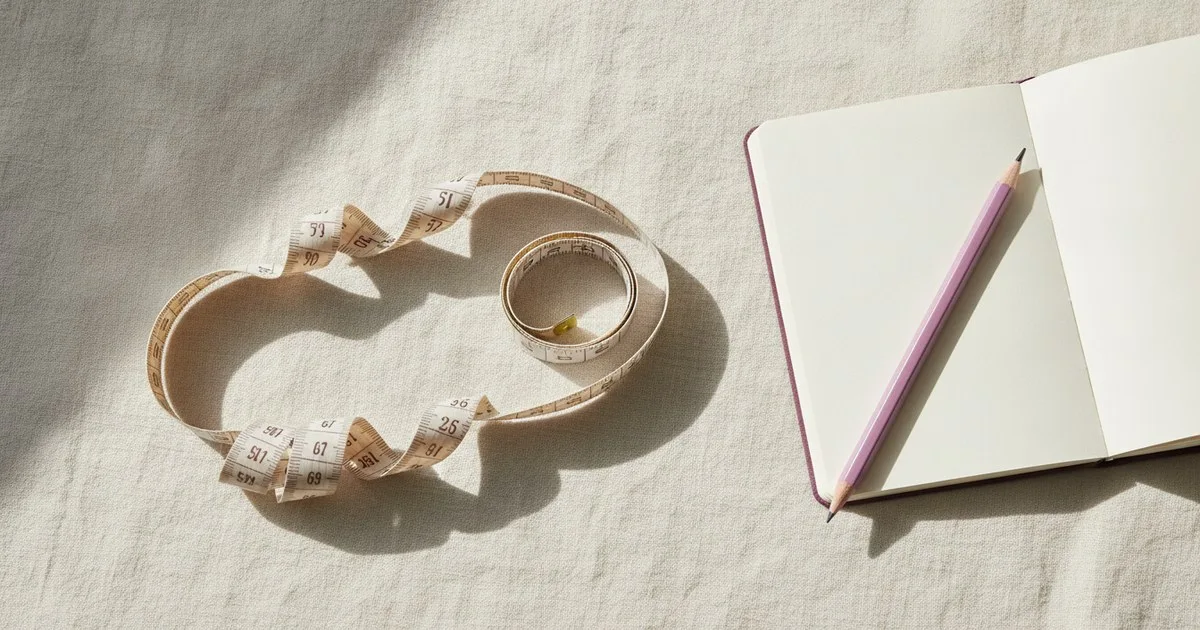
Taking your own measurements is the single most reliable thing you can do before buying clothes online. Ten minutes with a tape measure gives you numbers that work across every brand, every country, and every size chart — and they are yours to keep.
Key takeaways
- A soft tape measure, a mirror, and a friend (optional but helpful) are all you need to get started.
- The measurements that matter most for clothing are bust, waist, hips, and inseam — everything else is a refinement.
- Brand size charts vary significantly: your measurement in centimetres or inches is a more stable reference than any labelled size.
- Retail returns reached $890 billion in 2024, and fit is consistently cited as a leading reason — getting your numbers right is a small act with real consequences.
- AI-powered fit tools can translate your measurements into size recommendations automatically, but they work best when your input data is accurate.
What you need before you start
- A soft measuring tape (the kind used in sewing, not a rigid builder's tape)
- A full-length mirror, or a friend to help
- Form-fitting underwear or a bodysuit — bulky clothing distorts measurements
- A notepad or your phone to record numbers as you go
- Good posture: stand naturally, weight evenly distributed, not sucking in or pushing out
Keep the tape snug but not tight. It should lie flat against your skin without pressing in. If you can slide two fingers underneath comfortably, that is the right tension.
Step 1 — Measure your bust
What to do: Wrap the tape around the fullest part of your chest, usually across the nipple line, keeping it parallel to the floor all the way around. Let your arms hang naturally at your sides; do not hold them out.
Expected result: A single number in centimetres or inches. Write it down as "bust" or "chest." For bra sizing you will also want your band measurement (directly under the bust, where a bra band sits), but for clothing the fullest-point measurement is what size charts use.
If the tape dips at the back, it is sitting too low. Adjust until it is level all the way around before reading the number.
Step 2 — Measure your waist
What to do: Find the narrowest part of your torso — typically an inch or two above your navel, not at the navel itself. Wrap the tape around that point, exhale naturally, and read the number. Do not hold your breath in.
Expected result: Your natural waist measurement. This is different from your trouser waistband size, which sits lower on most people. Note both if you plan to buy trousers or skirts with a defined waistband.
Scientific measurement protocols, including those used by the National Health and Nutrition Examination Survey, place the waist at the uppermost lateral border of the hip bone — a slightly lower point than the narrowest waist. For clothing, the narrowest point is more useful; for health tracking, the bony landmark matters. Know which you are measuring.
Step 3 — Measure your hips
What to do: Stand with your feet together. Wrap the tape around the fullest part of your hips and seat — usually 7 to 9 inches below your natural waist, though this varies by body shape. Keep the tape parallel to the floor.
Expected result: Your hip circumference. This number is critical for trousers, skirts, and fitted dresses. If you are between sizes, the hip measurement is usually the one to prioritise for comfort.
Step 4 — Measure your inseam
What to do: This one is easier with a friend. Stand straight with your feet about hip-width apart. Have your friend place the tape at your crotch seam (where a pair of trousers would sit) and measure straight down to the floor, or to wherever you want the hem to fall.
Alternatively: Measure a pair of trousers you already love. Lay them flat, find the crotch seam, and measure from there to the hem along the inner leg.
Expected result: An inseam length in inches or centimetres. Most brands list inseam options (short, regular, long, or specific numbers) — having your own figure means you can match rather than guess.
Step 5 — Add the refinements that matter for your wardrobe
The four measurements above cover most purchases. Depending on what you buy most often, consider adding:
- Shoulder width: Measure across the back from the edge of one shoulder to the other, following the seam line. Crucial for structured jackets and coats.
- Sleeve length: From the top of your shoulder, down over a slightly bent elbow, to your wrist bone.
- Torso length / back length: From the most prominent bone at the base of your neck (the seventh cervical vertebra) straight down to your natural waist. Useful for jumpsuits and one-pieces.
- Thigh circumference: Around the fullest part of your upper thigh. Relevant for fitted trousers and some shorts.
- High hip: About 3 to 4 inches below the natural waist, above the fullest hip point. Useful for low-rise styles.
Re-measure every six months, or after any significant change in weight or body composition. Body dimensions shift, and measurements taken two years ago may no longer serve you.
Step 6 — Read a brand size chart correctly
Once you have your numbers, the temptation is to find the size that matches most of your measurements. In practice, size charts require a little more nuance:
- Always use the brand's own chart, not a generic one. A size 12 at one label is a size 14 at another.
- Match the measurement the garment is cut for. A shift dress is sized to the bust; a pencil skirt is sized to the hips. Identify the dominant measurement for the silhouette.
- When you fall between two sizes, go up for comfort in structured pieces (blazers, tailored trousers) and use your judgement for stretch fabrics, which accommodate a wider range.
- Check the ease notes. Some brands note whether a garment is cut close, relaxed, or oversized. A "relaxed fit" shirt sized to your bust may swamp you; a "slim fit" at the same size may be exactly right.
- Look at the model's measurements if listed. If the model is 5'10" wearing a size 8 and you are 5'4", the hem length and proportions will fall differently on you.
Step 7 — Use a fit tool to cross-check your size
Several brands now embed AI-powered fit tools directly on their product pages. These work by taking your measurements — or a few simple inputs — and returning a size recommendation specific to that garment's cut and fabric.
True Fit is one of the more widely deployed of these: it appears on the product pages of many mid-to-large fashion retailers and uses a combination of your measurements, past purchases, and garment data to suggest a size. The more purchase history you give it, the more refined its recommendations become.
Bold Metrics takes a different approach, building what it calls a digital twin from your body data — mapping a detailed set of body dimensions — and using that to predict fit across a brand's range. Brands integrate it as a Smart Size Chart or Virtual Sizer on their sites, so you may encounter it without knowing the name behind it.
3DLOOK offers body scanning from two smartphone photos, extracting a detailed set of body measurements in under a minute. Its technology is primarily used by brands and platforms building fit tools into their own apps and services, so you are more likely to encounter it as the engine behind a retailer's scanning feature than as a standalone consumer product.
These tools are most useful as a cross-check, not a replacement for your own measurements. If a tool's recommendation conflicts with what your tape measure tells you, trust the tape and read the garment's size chart manually.
Troubleshooting common problems
The tape keeps slipping. Use a clip or a safety pin to hold one end in place while you wrap, or ask a friend to hold it at the starting point.
My measurements put me in different sizes for different brands. This is normal. Sizing is not standardised across the industry. Your measurements are consistent; the labels are not. Keep your numbers and match them to each brand's chart individually.
I measured myself twice and got different numbers. Check your posture (are you standing the same way each time?), your tape tension (snug but not tight), and whether the tape is level. Small variations of half a centimetre are normal; larger ones suggest the tape is angling or you are measuring at slightly different points.
The size chart only goes by bust, but I need the hip measurement. Some brands, particularly those focused on tops, publish limited charts. In that case, search for customer reviews from people who share your measurements, or contact the brand's customer service — many will give you garment measurements on request.
I ordered the right size and it still does not fit. The garment's actual measurements may differ from the size chart, or the cut may simply not suit your proportions. This is a design issue, not a measurement error. Some brands publish the garment's actual flat measurements (chest width, hem width, length) alongside the size chart — these are more reliable than labelled sizes alone.
What success looks like
When your measurements are accurate and you are reading size charts carefully, you should find that your first-choice size fits well the majority of the time. You will still occasionally need to return something — fabric behaviour, cut, and proportion vary too much for any system to be perfect — but the guesswork shrinks considerably. The environmental and financial cost of returns is real: total retail returns reached $890 billion in 2024, and reducing even a handful of your own returns each year adds up across a wardrobe.
FAQ
How do I measure myself for online clothes shopping if I am alone? A full-length mirror helps enormously. Use a clip to hold the tape at the starting point, wrap it around, and read the number in the mirror. For inseam, measuring a well-fitting pair of trousers flat on a table is more accurate than trying to reach your own crotch seam.
How often should I re-take my measurements? Every six months is a reasonable habit, or after any noticeable change in weight or fitness. Measurements taken more than a year ago are worth refreshing before a significant purchase.
What is the difference between my waist measurement and my trouser size? Trouser sizes are labelled in inches but rarely correspond to an actual waist measurement — they are often an inch or two smaller than the garment's real waistband. Always check the brand's size chart against your tape measurement rather than ordering by the number on the label.
Should I measure over clothes or directly on my body? Directly on your body, or over very thin, form-fitting underwear. Anything thicker adds bulk and inflates your measurements.
Do AI fit tools replace taking my own measurements? Not entirely. They are useful for translating your measurements into brand-specific size recommendations, and some can refine suggestions using your purchase history. But they rely on accurate input — if your measurements are off, the recommendation will be too. Your tape measure is still the foundation.