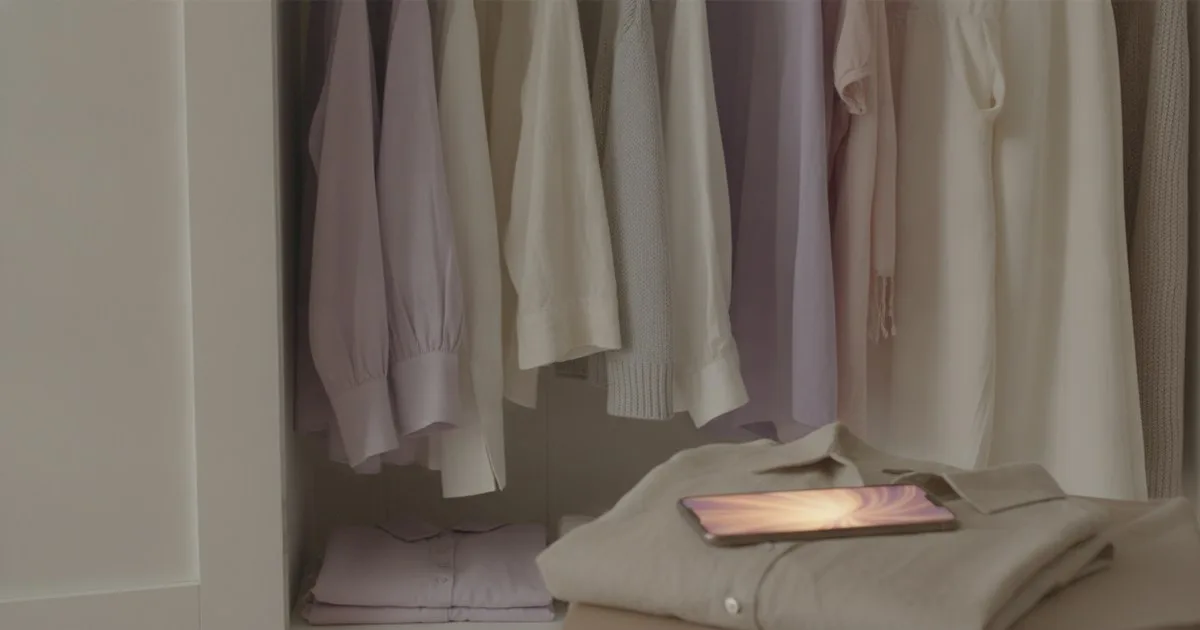
Wardrobe apps ask you to photograph every item you own, log what you wear each day, and let an algorithm suggest tomorrow's outfit. The promise is genuine: less decision fatigue, fewer impulse purchases, a clearer sense of what you actually reach for. But the catalogue you build inside these apps is one of the most intimate datasets you will ever hand to a company — a precise, item-level record of your taste, your budget, your body, and your daily habits. Before you photograph your fortieth blouse, it is worth understanding what happens to that information once it leaves your phone.
Key takeaways
- Wardrobe apps collect layered personal data — images, body measurements, purchase history, and daily wear patterns — that together paint a detailed portrait of who you are.
- Much of this data can be shared with third-party advertisers and data brokers, often under terms most users never read.
- AI-powered features, including virtual try-on, add a biometric dimension that raises the privacy stakes further.
- Regulatory frameworks are tightening, but enforcement remains uneven and many apps operate across jurisdictions that give consumers little practical recourse.
- You have real options: reading permissions carefully, limiting photo-level detail, and choosing platforms with clear data-minimisation policies can meaningfully reduce your exposure.
What data does a wardrobe app actually collect?
The obvious layer is your clothing catalogue: photographs, categories, colours, brands, price points. But most apps collect considerably more than that.
When you log an outfit, the app records the date, the weather (often pulled automatically via your location), the occasion, and sometimes your mood. Over weeks, that produces a behavioural timeline — what you wear to work, what you reach for when you are anxious, how your choices shift with the seasons. Some platforms ask for your measurements or body shape to power fit recommendations. Others connect to your email to parse delivery confirmations and build a purchase history you never manually entered.
The result is not a digital wardrobe. It is a profile.
The hidden data flows: third parties and data brokers
The profile you build does not necessarily stay inside the app. Most consumer apps, including fashion ones, operate within an advertising ecosystem in which data is shared — sometimes sold, sometimes licensed — with networks of third parties whose names never appear in the app itself.
Research from the Norwegian Consumer Council found that every time users open apps, hundreds of third-party entities can receive personal data about their interests, habits, and behaviour — and that the advertising industry has systematically collected and used this data in ways that regulators have found to be unlawful. That finding was about apps broadly, but fashion and lifestyle apps sit squarely in the category the report examined.
Data brokers aggregate signals from many sources and sell enriched profiles to retailers, insurers, and marketers. Your wardrobe app data — combined with your location history, browsing behaviour, and purchase records from elsewhere — can contribute to a profile far more granular than any single company holds alone.
How AI features change the privacy calculation
The newer generation of wardrobe tools goes beyond cataloguing. Virtual try-on features ask you to upload a photograph of yourself — sometimes a full-body image — so the app can render garments on your likeness. Style-recommendation engines analyse your catalogue and your stated preferences to predict what you will want next. Some platforms use computer-vision models to tag your existing clothes automatically.
Each of these features requires more data, and some of it is biometric. A photograph of your body used to simulate fit is not the same as a photograph of a coat: it captures physical characteristics that are protected under privacy law in many jurisdictions and that cannot be changed if they are compromised.
Google's virtual try-on, now integrated directly into Google Search and Shopping, lets shoppers upload a selfie and see apparel rendered on their body within search results. Google has the infrastructure and regulatory scrutiny that comes with being one of the world's largest data companies, which means its data practices are more visible than those of a small startup — but it also means the data feeds into one of the most extensive consumer profiles in existence. The trade-off is real either way.
Retail AI platforms such as Vue.ai work primarily on the brand side rather than directly with consumers, handling product tagging, personalised recommendations, and virtual dressing-room experiences for retailers. When you interact with a try-on or recommendation feature on a retailer's website, there may be an enterprise AI layer behind it that the retailer's own privacy policy covers only partially.
What do the terms of service actually say?
Most wardrobe apps are free, which means the product is, in some sense, you. The terms of service — which almost nobody reads in full — typically grant the platform a broad licence to use your data for product improvement, which can include training AI models on your photographs and style choices. Some grant rights to share anonymised or aggregated data with partners. A few are explicit about advertising use; many are not.
The practical problem is that "anonymised" is a weaker protection than it sounds. Research consistently shows that clothing preferences, body measurements, and geographic patterns can be used to re-identify individuals even after names are removed. Your wardrobe, in other words, may be more identifiable than your name.
A broader FTC staff report published in September 2024 found that large platforms collected and could indefinitely retain troves of data, including information from data brokers, and about both users and non-users, with data handling controls described as "woefully inadequate." The report focused on social media and streaming companies, but the structural patterns it identified — broad data sharing, indefinite retention, inadequate oversight — are common across consumer apps.
The investment signal: what it tells you about the business model
Digital wardrobe platforms have attracted serious attention from some of the largest players in retail and technology. Whering, a London-based wardrobe app, secured a seed funding round from the Google AI Futures Fund and eBay Ventures, with the CEO describing how the investment will expand the platform's AI capabilities. That two of the largest e-commerce and search companies in the world see strategic value in a wardrobe app tells you something about what wardrobe data is worth to the commerce ecosystem.
This is not a reason to avoid these tools. It is a reason to read their privacy policies as carefully as you would a financial product's terms — because the data you are providing has commercial value, and understanding that value helps you decide whether the exchange is fair.
Trend-forecasting firms, including Heuritech — now part of Luxurynsight's luxury data-intelligence platform — use aggregated consumer signals to predict what styles will sell. The more granular the consumer data flowing into the fashion ecosystem, the more accurate those predictions become. Your daily outfit log, at sufficient scale, is a market-research instrument.
What you can actually do about it
Privacy in consumer apps is not binary. There is a spectrum between sharing everything and using nothing, and most people can find a position on it that preserves the utility they want.
Before you download:
- Read the privacy policy, specifically the sections on data sharing and data retention. Look for whether the app sells data to third parties, and whether it trains AI models on user content.
- Check whether the app offers a paid tier. Paid products are less likely to depend on data monetisation, though this is not a guarantee.
- Look at where the company is incorporated. Apps subject to GDPR (European Union) or similar frameworks carry stronger baseline obligations than those operating only under US state law.
When you set it up:
- Grant only the permissions the app needs to function. Location access is rarely essential for a wardrobe catalogue; deny it unless you have a specific reason to share it.
- Avoid connecting your email for purchase parsing unless you are comfortable with the app reading your inbox.
- Use generic descriptions rather than brand names and prices if you are uncomfortable with that level of detail being stored and potentially shared.
As you use it:
- Periodically review what data the app holds and whether the platform offers a data export or deletion request. Under GDPR and several US state laws, you have the right to request deletion.
- Be especially cautious with any feature that asks for a full-body photograph. Understand what the platform does with that image before you upload it.
- If the app updates its terms of service, treat it as a prompt to re-read the relevant sections. Material changes to data use often arrive quietly.
The bigger picture:
The fashion industry is moving rapidly toward AI-powered personalisation, and the data that powers it has to come from somewhere. As Just Style noted in a recent review of the sector, fashion's AI ambitions are running ahead of the trust and governance frameworks needed to support them. That gap is the consumer's problem to navigate for now.
None of this means wardrobe apps are inherently harmful. Used thoughtfully, they can genuinely reduce overconsumption — one of the more meaningful things an individual can do within the fashion system. The point is simply that the convenience is not free, and the currency is your data. Knowing what you are spending makes the decision yours.
FAQ
Do wardrobe apps sell my data to advertisers? It depends on the platform. Many share data with third-party advertising networks, either directly or through analytics tools embedded in the app. The privacy policy — specifically the sections on data sharing and third-party partners — is the only reliable way to find out what a specific app does.
Are virtual try-on photos stored permanently? Policies vary. Some platforms process images transiently and delete them after the session; others retain them to improve their models. Check the privacy policy for image retention terms, and if it is unclear, treat the image as stored indefinitely.
Is my wardrobe data protected under GDPR? If you are in the EU and the app is subject to GDPR, you have rights to access, correct, and delete your data, and the company must have a lawful basis for processing it. Apps incorporated outside the EU may still be subject to GDPR if they target EU users, but enforcement is uneven.
Can wardrobe apps use my photos to train AI models? Many terms of service grant the platform a licence to use your content for product improvement, which typically includes AI training. If this concerns you, look for platforms that explicitly exclude user content from model training, or use a paid tier that may carry different terms.
What is the safest way to use a wardrobe app? Grant minimal permissions, avoid connecting your email or social accounts, use generic descriptions rather than brand names and prices, and choose a platform with a clear data-minimisation policy. Review your data periodically and request deletion if you stop using the service.
Further reading
- Whering CEO on why Google AI, eBay are betting on digital wardrobes — Just Style
- FTC Staff Report on Social Media Surveillance — Federal Trade Commission
- The advertising industry is systematically breaking the law — Norwegian Consumer Council