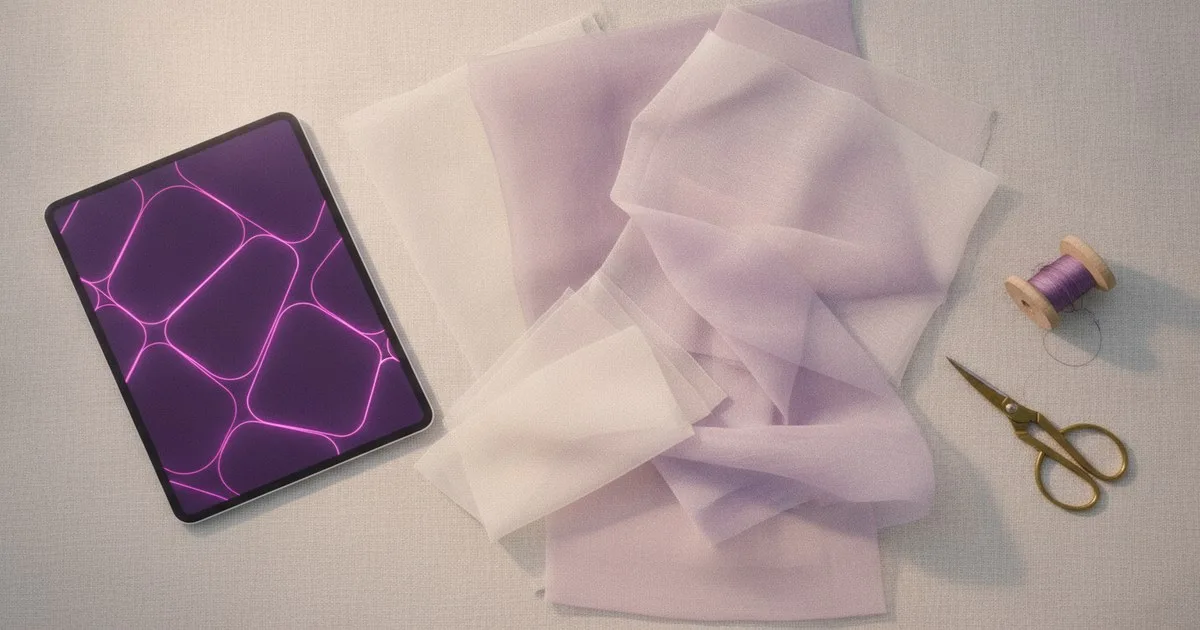
Most of what happens before a garment reaches a shop floor is invisible to the people who will eventually wear it. Patterns are drafted, fabrics are tested, samples are shipped across continents, rejected, and remade. A handful of startups have spent the last decade quietly dismantling that process—replacing physical prototypes with digital ones, and guesswork with data. Here are eight of them, and why what they built matters to you as a consumer.
Key takeaways
- Digital 3D sampling tools are reducing the number of physical garments made before a design is approved, cutting both waste and lead times.
- Fabric digitisation technology means a designer in New York can work with an accurate simulation of a textile woven in Japan—without touching it.
- AI-powered platforms are compressing the gap between a sketch and a production-ready tech pack from weeks to hours.
- Virtual fit and size recommendation tools, now embedded inside major retailers, grew out of specialist startups that proved the concept first.
- The trend running through all eight stories is the same: fewer physical objects made and discarded before the right one is produced.
1. What did Browzwear build, and why does it matter?
Browzwear
Browzwear is a Singapore-based company whose 3D digital product creation platform—built around its VStitcher, Lotta, and SmartDesign tools—lets fashion brands design garments using physics-based simulation rather than physical fabric and thread. A designer can drape a virtual pattern onto a digital body, watch it behave under simulated gravity, adjust the grain line, and share a photorealistic render for approval, all before a single sample is cut.
What makes this consequential for consumers is the reduction in sampling waste. The traditional development cycle can involve dozens of physical prototypes per style, most of which are discarded. Browzwear's platform compresses that process, and its open API—made generally available in late 2020—means brands can embed 3D design directly into their existing PLM and ERP systems rather than treating it as a separate step.
Today the platform also includes AI-driven fit validation and AI-generated on-model imagery, extending its reach from the design studio to the product page. The direction of travel is clear: a connected digital workflow from first sketch to factory floor, with physical sampling reserved for final confirmation rather than iterative exploration.
What is still worth watching is how quickly mid-market brands—not just large sportswear labels—can absorb the workflow change that 3D-first design requires.
2. How does fabric digitisation change what a designer can do?
Vizoo
A 3D garment simulation is only as convincing as the fabric data behind it. Vizoo solves that problem with its xTex™ hardware and software system, which scans real textiles at high resolution and captures the physical properties—weight, stretch, sheen, surface texture—that determine how a fabric moves and looks on a body.
The result is a digital material twin that a designer can drop into any major 3D design environment and trust to behave like the real thing. A brand sourcing a cotton poplin from a mill in Portugal can receive a Vizoo-scanned file and begin draping it digitally the same day, without waiting for a physical swatch to cross a border.
For consumers, the downstream effect is that the garment a brand photographs for its website increasingly reflects what will actually be produced. The gap between the aspirational image and the delivered product narrows when the simulation is built from real material data rather than approximation.
The company recently appointed a new CEO and is expanding its work into footwear and adjacent industries alongside apparel—a sign that the underlying technology has uses well beyond the original fashion context.
3. Can software simulate how a fabric actually looks in 3D?
Seddi
Where Vizoo captures physical fabric properties, Seddi focuses on the visual layer—how a textile renders in three dimensions for the purposes of design approval and client proofing. Its Textura.ai platform generates 3D digital textiles in the cloud, and its Decorator™ workspace creates true-to-pattern digital replicas of real blank garments for artwork placement and production instructions.
The practical effect is that a brand producing decorated or branded apparel—think a company producing embroidered workwear or printed sportswear—can show a client an accurate digital proof before any physical garment exists. Approval cycles that once required physical samples to travel between studios and clients can happen on a screen.
Seddi is positioning itself as the visual infrastructure layer for the branded apparel workflow, from concept through client approval to production. That is a quieter ambition than some of the more headline-grabbing AI plays in fashion, but it addresses a genuinely stubborn inefficiency: the time and material cost of physical proofing.
4. What happened when virtual prototyping became a research priority?
The EU's Future Fashion Design project
Before any of these tools reached commercial scale, the underlying research had to be done. A European Commission-funded project under the FP7 programme—Future Fashion Design, or FFD—set out to develop a business and production workflow that could represent the entire garment development process virtually, from concept to production-ready specification.
The project's central observation was that virtual prototyping could only fulfil its potential if it covered the full development chain, not just isolated steps. At the time, the whole chain could not be represented virtually, making it necessary to acquire data from physical samples at multiple points. The FFD project aimed to close those gaps.
Why does this matter now? Because the commercial tools that brands use today—including the platforms described in this list—are building on a foundation of research that established what was technically possible and what the workflow needed to look like. The EU's investment in that foundational work helped accelerate a transition that is now visibly reshaping how clothes are made.
What remains unresolved is the pace of adoption across the long tail of smaller manufacturers and suppliers, many of whom still work with paper patterns and physical samples as their primary method.
5. How is AI changing the design-to-production handoff?
Cala / Mercer
The handoff between a designer's creative vision and a factory's production requirements has always been where ideas get lost. Cala built a platform—now operating as Mercer—that tries to close that gap with AI. Mercer offers text-to-image design generation, AI design editing, tech pack collaboration, and access to a global manufacturing network, all within a single environment.
For an independent designer or a brand without a large technical team, the significance is real: the platform can take a concept and help move it toward a production-ready specification without requiring a specialist at every step. The tech pack—the document that tells a factory exactly how to construct a garment—is one of fashion's most labour-intensive artefacts. Anything that accelerates its creation without sacrificing accuracy changes the economics of bringing a new design to market.
Mercer is positioning itself as an all-in-one platform for concept, design, production, and logistics, with ongoing development of product templates and expanded AI features. The open question is whether a single platform can genuinely serve both independent designers and established brands without compromising depth for either.
6. What did virtual try-on look like before it was mainstream?
Zeekit
Virtual try-on is now a feature on major retail websites, but the technology was pioneered by startups working years before the major platforms adopted it. Zeekit built real-time image processing and AI tools that simulate how clothing looks on a shopper's actual body—not a generic model, but the person looking at the screen.
The company was acquired by Walmart and now operates as part of that business, providing virtual try-on capability integrated into Walmart's online fashion shopping experience. The acquisition is a useful marker of how the technology matured: what began as a specialist startup's proposition became, within a few years, something a major retailer considered essential enough to buy outright.
For consumers, the promise of virtual try-on is a reduction in the returns that cost both money and environmental resources. A garment returned because it looked different in person than online is a small individual inconvenience but a significant collective problem. The startups that built this category were, in effect, working on that problem before most retailers had framed it that way.
7. How did fit data become a strategic asset for fashion brands?
Fit Analytics
Size recommendation—the technology that suggests which size a shopper should order based on their measurements and a brand's fit history—was another category built by startups before it became infrastructure. Fit Analytics developed tools that analyse fit data across brands and body types to surface a personalised size recommendation at the moment of purchase.
The company was acquired by Snap Inc. and its Fit Finder technology now operates inside Snap's commerce and augmented reality stack. The trajectory mirrors Zeekit's: a specialist capability, proven by a startup, absorbed into a larger platform once its value was established.
What the Fit Analytics story signals about the category is that fit data—the accumulated knowledge of how a brand's garments actually fit real bodies—is now understood as a strategic asset, not an afterthought. Brands that built that data early have a material advantage in personalisation and returns reduction. Those that did not are now trying to catch up.
8. What does trend forecasting look like when it runs on computer vision?
Heuritech
Fashion forecasting has traditionally relied on a combination of runway analysis, retail sell-through data, and the intuition of experienced buyers. Heuritech applied computer vision to social image data at scale, identifying emerging trends from the visual content people were actually sharing—before those trends appeared in trade reports.
The company was acquired by Luxurynsight and now operates as part of that business's luxury data-intelligence platform, with its trend signals integrated into a broader market-intelligence suite. The acquisition reflects a consolidation happening across fashion data: specialist capabilities being folded into larger platforms that can offer brands a more complete picture.
For consumers, the downstream effect of better trend forecasting is, in theory, less overproduction—fewer garments manufactured speculatively that end up marked down or destroyed. Whether that efficiency gain translates into genuine reduction in waste or simply into faster cycles of new product depends on choices that brands make, not just on the tools they use. That tension is worth watching as computer-vision forecasting becomes standard rather than novel.
What connects all eight?
The thread running through every story here is the same: a step in the production chain that once required a physical object—a sample, a swatch, a fitting session, a printed trend report—has been partially or fully replaced by a digital process. That shift is not complete, and it is not uniformly distributed across the industry. Large brands with the resources to invest in new workflows have moved faster than smaller ones. But the direction is consistent, and the startups that proved each step was possible did the work that made the broader shift imaginable.
The WIPO's analysis of sustainable fashion technologies identifies material production and textile processing as areas with particularly high potential for environmental benefit through innovation—and several of the tools described here address exactly those stages. The commercial and the environmental cases for digital production are, increasingly, the same case.
FAQ
What is fashion tech, in plain terms? Fashion tech refers to software, hardware, and data tools that change how clothes are designed, produced, or sold. In production, that includes 3D sampling software, fabric digitisation tools, and AI platforms that generate tech packs. In retail, it includes virtual try-on and size recommendation.
Do these tools actually reduce waste? Digital sampling reduces the number of physical prototypes made before a design is approved. Fewer prototypes means less fabric cut and discarded. The reduction is real, though the scale varies by brand and by how fully a company has adopted digital workflows.
How does virtual try-on work? Virtual try-on uses image processing and AI to simulate how a garment looks on a specific body, based on measurements or a photo. The technology was pioneered by startups and is now integrated into several major retail platforms.
Are these tools only for large brands? Not any more. Platforms like Mercer are designed for independent designers and smaller brands. 3D sampling tools have also become more accessible as the software has matured and subscription pricing has become more common.
What is a tech pack, and why does it matter? A tech pack is the document that tells a factory exactly how to construct a garment—measurements, materials, stitching, hardware, labelling. It is the primary communication between a designer and a manufacturer. Errors or gaps in a tech pack cause costly production mistakes, so tools that help create accurate tech packs faster have a direct effect on quality and efficiency.
Further reading
- Stages in the fashion and textiles value chain with high innovation potential for environmental benefits — WIPO
- Future Fashion Design — EU FP7 research project, CORDIS